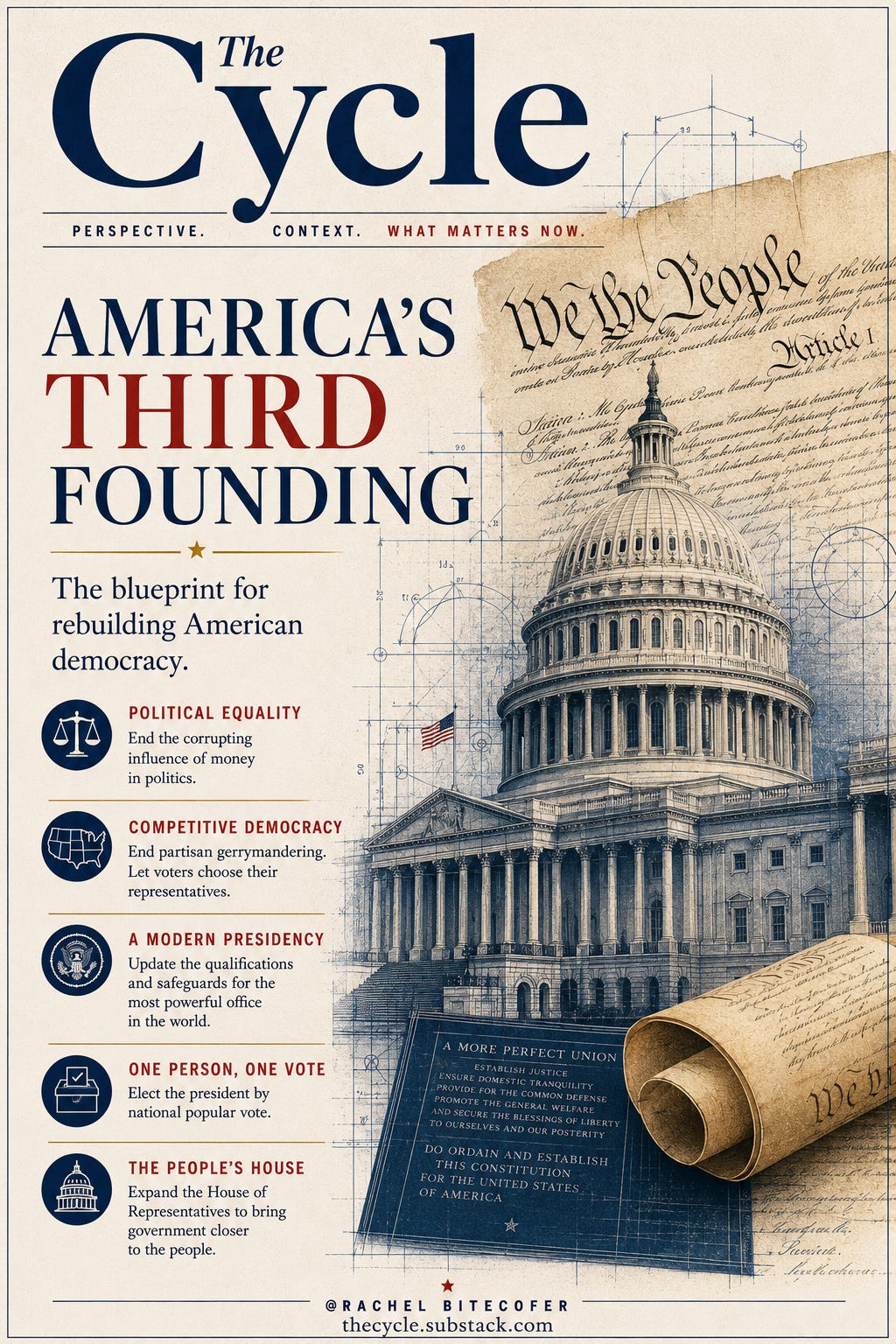
America's Third Founding:
In the wake of whatever Trump does, America needs to get its constitutional house in order
Americans love to debate how to fix our democracy.
End Citizens United. Abolish the Electoral College. Ban partisan gerrymandering. Expand the House of Representatives. Impose congressional term limits. Prevent another corrupt president from abusing the powers of the office.
One of the greatest failures of American civic education is that we teach people what government does, but rarely how government changes. We memorize the three branches of government and the Bill of Rights, yet few Americans understand the difference between constitutional law and ordinary legislation—or why that distinction determines whether a reform is politically possible.
The United States has already been founded twice.
The first founding came in 1787, when the Constitution established a new system of government unlike any the world had seen. The Bill of Rights soon followed as the political compromise that secured ratification, creating the constitutional framework that has endured for more than two centuries.
The second founding came after the Civil War.
The nation nearly destroyed itself over slavery and secession. Four years of unimaginable bloodshed settled the question of whether the Union would survive, but victory on the battlefield was only the beginning. During Reconstruction, Congress required the former Confederate states to ratify the Thirteenth, Fourteenth, and Fifteenth Amendments before they could fully reclaim representation in the federal government.
Those amendments transformed the Constitution. They abolished slavery, established birthright citizenship, guaranteed equal protection and due process, and prohibited denying the right to vote on the basis of race. The Fourteenth Amendment, in particular, became the constitutional foundation for much of modern American liberty. Many of the civil rights and individual freedoms Americans take for granted today trace directly back to the Second Founding.
Every generation inherits the Constitution, but only one generation has had an opportunity to fundamentally remake it: the Civil War generation.
Today, America faces another constitutional moment, not because states are preparing to leave the Union, but because many of the assumptions built into an eighteenth-century Constitution no longer fit the realities of twenty-first-century politics. Unlimited campaign spending, partisan gerrymandering, an Electoral College that can reject the national popular vote, and growing concerns about presidential accountability have exposed weaknesses the Framers could never have anticipated.
Yet our political debate almost always skips over the most important question.
Can these problems actually be fixed? Some can, most cannot—at least not through ordinary legislation. Congress cannot abolish the Electoral College. It cannot rewrite the constitutional qualifications for the presidency. It cannot simply declare that money is no longer protected political speech if the Supreme Court continues to interpret the First Amendment as it does today.
To do these things the Constitution itself must be changed and the process to do so is arduous- hard to pull off in the best of times and these are not the best of times.
To amend the Constitution you need a 2/3rds vote in both chambers of Congress and ratification by 3/4s of the states. This is why despite passing through both the House and Senate, the Equal Rights Amendment failed to reach ratification.
In a country that can’t even pass a budget through normal legislation those barriers aren’t just hard, they are impossible. The last time we successfully amended the Constitution it was in 1996 and the issue was preventing congress from giving itself current-term pay raises. Hardly controversial.
History teaches us that America’s greatest constitutional reforms have never emerged from ordinary politics. They have emerged from extraordinary crises. The Constitution replaced the failed Articles of Confederation. The Reconstruction Amendments followed the Civil War. Each founding was born from a national reckoning that forced Americans to rethink the rules by which they governed themselves.
If America experiences another constitutional reckoning, we should not waste it. We should already know which reforms would strengthen our democracy—and what it would actually take to achieve them.
That is the purpose of this essay.
Reform One: Restoring Political Equality
Democracy rests on a simple promise: every citizen is politically equal.
Not economically equal. Not socially equal. Politically equal.
Every American gets one vote, and every vote carries the same weight. The legitimacy of democratic government depends on the idea that no citizen’s voice should count more than another’s simply because of wealth.
For most of American history, that principle was imperfectly realized but broadly understood. Wealthy Americans have always enjoyed advantages in politics, but there was also broad agreement that government could place reasonable limits on the role of money in elections to protect the integrity of representative government.
Over the past several decades, however, the Republican-controlled Supreme Court has moved in a different direction. Building on earlier decisions, the Court concluded that spending money to advocate for political candidates is protected by the First Amendment because money enables political speech. That constitutional reasoning reached its most famous expression in Citizens United v. Federal Election Commission.
Its practical effect has been unmistakable.
Modern American elections are now dominated by an arms race of Super PACs, billionaire donors, dark money organizations, and outside spending that would have been almost unimaginable a generation ago. Every citizen still receives one vote, but not every citizen possesses the same political voice. Those with extraordinary wealth can spend virtually unlimited sums shaping campaigns, financing advertisements, and influencing the political conversation.
Many Americans believe that is inconsistent with the democratic ideal of political equality. The question becomes: how do we change it?
There are only two realistic paths.
The first is judicial. A future Supreme Court could reverse or substantially narrow Citizens United and related decisions, concluding that the First Amendment permits greater regulation of money in politics than the current Court recognizes.
The second is constitutional.
A Third Founding could amend the First Amendment to make clear that while political speech enjoys the highest constitutional protection, the use of money to influence elections may be subject to reasonable regulation in order to protect political equality and democratic self-government.
Notice what is missing from those options.
Congress alone cannot simply pass a law declaring that money is no longer protected speech. As long as the Supreme Court continues to interpret the First Amendment as it does today, any law fundamentally inconsistent with that interpretation is likely to be struck down.
This is the difference between ordinary legislation and constitutional law. When a reform conflicts with the Constitution as interpreted by the Supreme Court, changing the law is not enough. The constitutional rule itself must change.
If democracy means that every citizen enters the voting booth as a political equal, then restoring that equality should begin by asking whether our Constitution should continue to treat unlimited political spending as indistinguishable from political speech.
And while we’re in there clarifying free speech we should probably find a way to regulate campaigns ads as they are regulated in other democracies. America is the Wild West of elections and the only democracy that allows political ads to openly lie to you.
Reform Two: Restoring Competitive Democracy
Political equality does not end with campaign finance. Even if every American had exactly the same political voice, democracy still depends on another fundamental principle: voters should choose their representatives—not the other way around.
That principle has been steadily eroded by partisan gerrymandering.
Every ten years, after the census, states redraw legislative and congressional district lines to reflect population changes. Redistricting is both necessary and constitutional. Gerrymandering is something entirely different.
Partisan gerrymandering occurs when those drawing district lines intentionally manipulate them to maximize one party’s electoral advantage. By packing opposition voters into a small number of districts and spreading their own supporters efficiently across many others, politicians can predetermine election outcomes years before a single vote is cast.
The result is fewer competitive elections, more safe seats, and a Congress increasingly populated by representatives who fear primary challengers far more than general-election voters.
That has profound consequences.
When elections cease to be competitive, politicians have less incentive to persuade independent voters, compromise across party lines, or govern from the political center. Instead, they often respond primarily to the most ideologically committed voters in their own party because, in many districts, the primary election is the only contest that truly matters.
Competitive elections are not a flaw in democracy.
They are one of democracy’s greatest strengths.
When representatives know they can lose, they become more responsive. They must defend their records, justify their decisions, and earn the support of a broader cross-section of the electorate. Competition is the engine of accountability.
Unlike many of the reforms discussed in this essay, Congress already possesses substantial constitutional authority to address partisan gerrymandering in elections to the U.S. House of Representatives.
A national law could prohibit partisan gerrymandering, establish transparent and uniform redistricting standards, and require congressional districts to maximize genuine electoral competition whenever doing so is consistent with equal population, compliance with the Voting Rights Act, and other legitimate redistricting principles.
Such a law would not require amending the Constitution.
It would require Congress to act. That means assembling legislative majorities, securing the president’s signature, navigating whatever Senate rules are in place at the time, and ensuring that any resulting law survives judicial review. Those are significant political obstacles, but they are fundamentally different from constitutional obstacles.
The purpose of redistricting should never be to maximize Democratic victories or Republican victories.
It should be to maximize democratic accountability.
The healthier our democracy, the more elections are decided by voters instead of mapmakers. A Third Founding should ensure that politicians once again compete for citizens—not design districts to protect themselves from them.
Reform Three: Modernizing the Presidency
The Framers could not have imagined the modern presidency.
In 1787, the president led a small republic with no standing intelligence community, no nuclear weapons, no global military presence, and a federal government that was tiny by modern standards.
Today, the president commands the most powerful military in human history, oversees the nation’s intelligence agencies, receives the government’s most sensitive classified information, appoints thousands of federal officials, and possesses enormous influence over nearly every aspect of American life.
The office has changed dramatically.
The Constitution has not.
Article II establishes remarkably few qualifications for the presidency. A president must be a natural-born citizen, at least thirty-five years old, and have lived in the United States for at least fourteen years.
That was enough in 1787, but clearly not enough today.
A modern president exercises extraordinary authority over national security and the preservation of constitutional government itself. The office demands not only political skill but also judgment, integrity, and the ability to safeguard some of the nation’s most closely held secrets. And because of the Supreme Court, presidents (at least our current one anyway) have near total immunity for actions- even blatantly criminal ones- its really important to prevent the next Donald Trump (if we survive this one).
Perhaps the constitutional requirements in Article I should be updated to require eligibility for access to classified information. We need stronger constitutional safeguards against corruption, clearer standards for disqualification after grave abuses of public office, or additional protections designed to preserve democratic institutions during periods of constitutional crisis.
Because trump has both criminal immunity for the Court he can not be convicted in an impeachment hearing without the cooperation of Republican senators who value their own power over safeguarding the constitutional order.
Unfortunately, Congress cannot simply create new constitutional qualifications for the presidency through ordinary legislation. The qualifications for the office are written directly into the Constitution itself. Altering them will require a constitutional amendment.
Reform Four: Electing the President by Popular Vote
The most basic principle of democracy is also the easiest to understand:
The candidate who receives the most votes should win.
In most American elections, that is exactly what happens. Presidential elections are the exception. Rather than electing the president directly, the Constitution created the Electoral College, awarding each state a number of electors equal to its representation in Congress. In nearly every state, whichever candidate wins the state’s popular vote receives all of its electoral votes, regardless of how close the election may be.
The result is a system unlike any other major election in American government. It is entirely possible for one candidate to receive millions more votes nationwide and still lose the presidency, like Hillary Clinton did in 2016.
Supporters of the Electoral College argue that it protects federalism, encourages coalition-building across the states, and prevents presidential campaigns from focusing exclusively on the nation’s largest metropolitan areas.
Critics respond that the system does almost exactly the opposite.
Rather than encouraging candidates to campaign everywhere, it encourages them to campaign almost nowhere. Modern presidential elections revolve around a handful of competitive swing states while tens of millions of Americans living in safely Democratic or safely Republican states receive comparatively little attention. A Republican in California and a Democrat in Texas often find that their presidential votes carry little practical influence because the statewide outcome is virtually predetermined.
A national popular vote would change those incentives entirely.
Every vote would carry the same weight, regardless of where it was cast. Candidates would have reason to seek support in every state, every city, every suburb, and every rural community because every additional vote would count exactly the same.
Republicans are fully capable of winning the national popular vote, just as Democrats are. Trump won both the Electoral College and the popular vote in 2024. The question is not which party benefits. The question is whether the presidency should always be awarded to the candidate chosen by the greatest number of Americans.
Because the Electoral College is established by the Constitution, Congress cannot abolish it through ordinary legislation. Only a constitutional amendment can replace it with a direct national popular vote.
In a representative democracy, every citizen should possess an equal voice, an equal vote, and an equal claim on the presidency. If Americans truly believe that political equality is the foundation of democratic government, then the person elected president should always be the person chosen by the most voters.
Reform Five: Expanding the People’s House
The House of Representatives was never intended to remain the size it is today. When the Constitution was written, the Framers expected the House to grow as the nation grew. For more than a century, that is exactly what happened. After each census, Congress routinely added new seats so that representatives would continue to serve communities of manageable size.
Then Congress stopped.
In 1929, the House was permanently capped at 435 members.
At the time, the United States had a population of roughly 120 million people. Today, it is home to more than 340 million.
The number of representatives has remained frozen.
The number of people each representative serves has not.
The average member of the House now represents well over three-quarters of a million Americans—one of the highest representative-to-constituent ratios in the democratic world.
That distance matters.
Larger districts make campaigns dramatically more expensive, increasing candidates’ dependence on wealthy donors and outside organizations. They make it harder for ordinary citizens to know their representatives personally, harder for representatives to understand the communities they serve, and harder for challengers without substantial financial resources to compete.
Representative government becomes less representative when representatives become increasingly distant from the people. Unlike many of the reforms discussed in this essay, this one does not require amending the Constitution.
Congress already has the constitutional authority to expand the House. Doing so would require passing legislation through both chambers of Congress, obtaining the president’s signature, navigating whatever Senate rules—including the filibuster, if it remains in place—govern legislation at the time, and defending the law if it faced constitutional challenges in court.
Those political obstacles are significant.
But they are not constitutional obstacles. That distinction matters because it reminds us that not every major reform requires rewriting the Constitution. Some simply require the political will to use powers Congress already possesses.
A larger House would not solve every problem facing American democracy, but it would bring representatives closer to the people, make campaigns more accessible, reduce the influence of money by shrinking the scale and cost of House races, and strengthen the connection between citizens and their government.
The House of Representatives was created to be the people’s house. Between partisan gerrymandering and the refusal to expand the People’s House has lost touch with the people.
A Hard Rain’s Gonna Fall
History tells us that constitutional moments do not arrive because nations are ready for them. They arrive because nations have run out of alternatives. The First Founding followed the collapse of one government. The Second Founding followed the bloodiest war in American history. The Third Founding, if it comes, will almost certainly emerge from another period of profound national crisis.
I have spent my career studying American elections. I have learned to trust the fundamentals, not the daily headlines. The fundamentals tell me that Democrats are likely to perform well in both the 2026 midterms and the 2028 presidential election. But elections are only meaningful if the losing side accepts the result.
I do not believe Donald Trump will peacefully hand the presidency to a Democratic successor if he loses. I believe he will do exactly what he has done before: claim the election was stolen. I believe he will point to millions of allegedly illegal votes, argue that the outcome is illegitimate because he didn’t get the SAVE Act, and insist that he has a duty not to surrender power to people he declares to be criminals. I believe many elected Republicans will support him in that moment, just as they have repeatedly chosen party loyalty over constitutional principle. And I know that all the agencies that stopped him last time have been purged.
What happens after that, I cannot tell you. No one can. History becomes very difficult to predict once democratic systems stop following democratic rules. What I do know is that it will not end with everyone shaking hands and agreeing to disagree. It will end in a constitutional crisis unlike anything most living Americans have experienced.
If we are headed toward that moment, then we are asking the wrong question. The question is not simply how we survive it. The question is what comes after. If the old constitutional order breaks under the weight of its own failures, we cannot afford to improvise the next one. We should already know what institutions we want to build, what democratic principles we want to strengthen, and what constitutional reforms will produce a stronger republic than the one that failed.
That is why this conversation matters now—not after the crisis has begun, but before it arrives. The First Founding created the Republic. The Second Founding expanded liberty and equality. If history gives our generation the burden—and the opportunity—of a Third Founding, we must be ready to finish the work. We cannot wait until the old order has collapsed to decide what should replace it. The blueprint must be drawn before the foundation gives way. Only then can we hope not merely to preserve the American experiment, but to renew it for the generations that follow.


Absolutely. Perhaps creating a Project 2029 not unlike the despicable project 2026. Only this time being conscious of the rule of law, how it has been mishandled and how it can be repaired in explicit detail so the blueprint is available when the time is ripe.
Project 2025 and earlier long term actions of the right Neoliberals that are bearing fruit for them today and those with Billions of dollars have been designed to bring down our Democracy and take the government of America AWAY from the Citizens of America.......and that is what is happening today. For too long, too many politicians and too many Americans have been asleep at the wheel (and being brainwashed) into thinking, acting, and believing that the status quo is working......it is NOT and there MUST be change to fix the damage or it will just get worse than it is now......and it is bad..........