
Deciding Not to Suck
Final Autopsy Affirms the Democratic Party's Brand is in Tatters

A Tough Rx from the Doc
When they called to pre-brief me on the Deciding to Win report, I said, “Let me guess—your findings are that our brand is fucked because it’s weak, woke, and weird.”
To his credit, study co-author Simon Bazelon chuckled and said, “Well, I wouldn’t put it that way.”
But he didn’t have to. That’s what the data says.
The Diagnosis
A year out of the election we’ve got gold-standard post-2024 data affirming what I’ve been yelling about since the day we lost the 2024 election: the Democratic Party doesn’t have an economic brand.
Not just a weak one.
None.
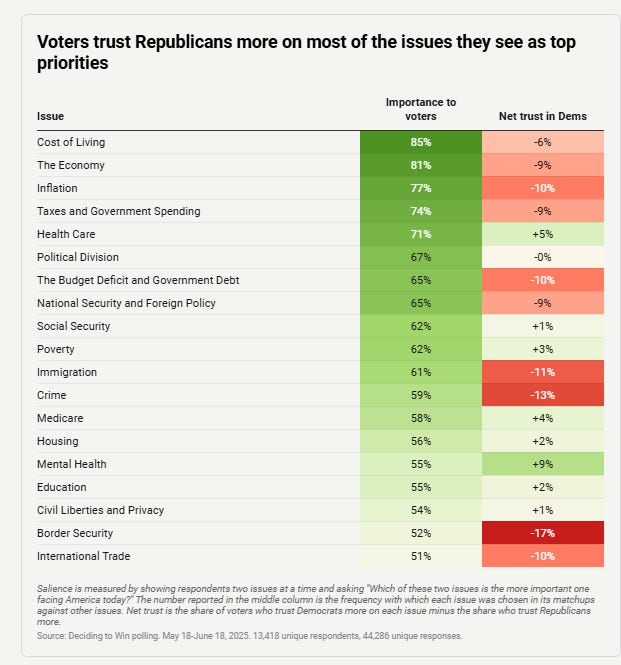
Remember this graph from Democratic research firm Blue Rose Research? I showed it to Simon and explained that voters were just as likely to answer Republicans on a host of the Democratic Party’s bread and butter economic polices like Social Security and Medicare.
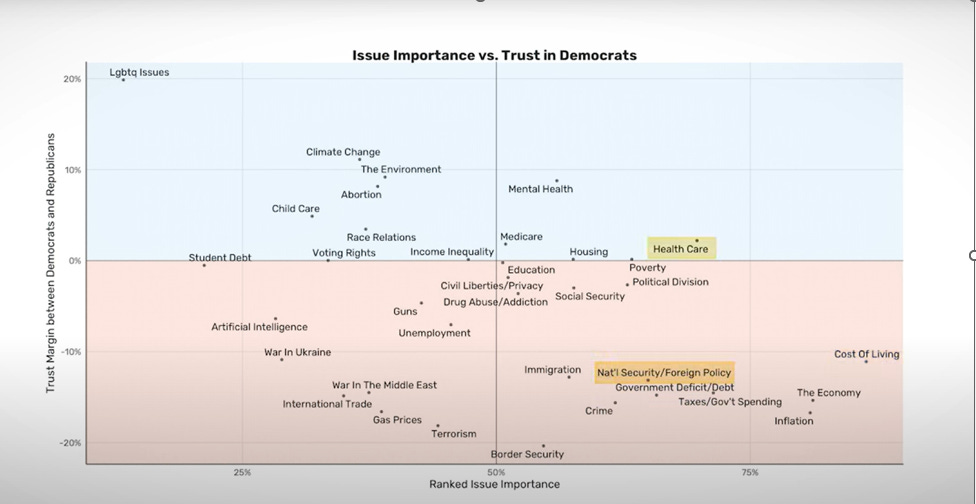
That’s bad considering conservatives always hated these programs, worked to block them from being enacted, and have moved to undermine them continuously for the past 20 years.
Voters can’t tell you what we stand for economically. In fact, half the country doesn’t even know if Democrats are better on housing, health care, and education, all issues the Democratic Party is supposed to “own.”
Meanwhile, Republicans have successfully branded Democrats as the party of chaos—of slogans, culture wars, and moral superiority. And because we’ve ceded the economic lane, voters now associate “Democrat” with words like “elite,” “out of touch,” and “weird.”
The Data Is Brutal
The Deciding to Win report pulls no punches. It shows:
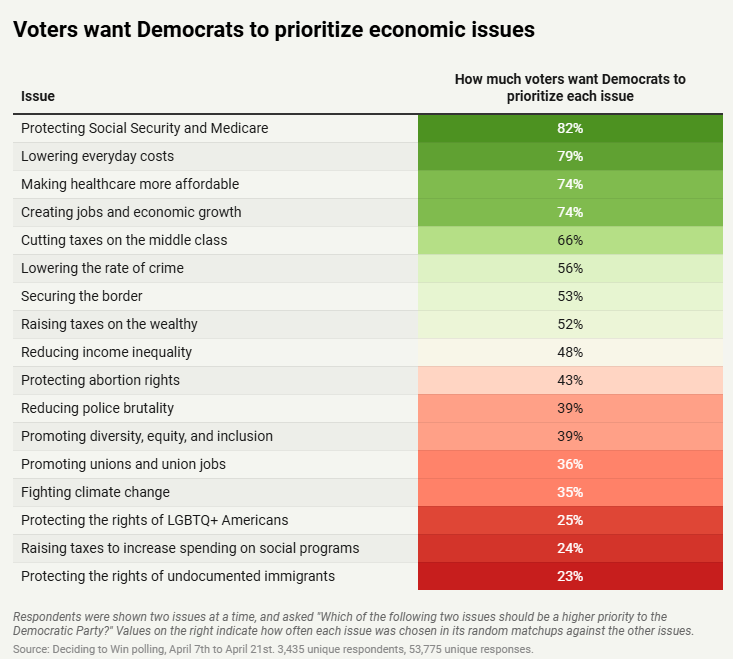
Voters think Democrats focus way too much on climate change, abortion, democracy, and identity politics—and not nearly enough on jobs, prices, healthcare, and public safety.
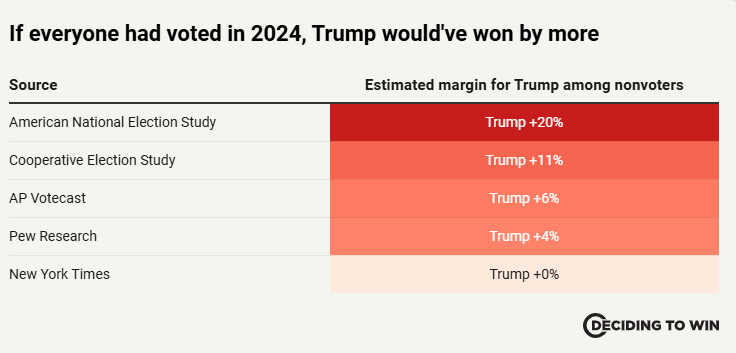
We’ve lost ground with every working-class demographic: down double digits among non-college Black, Latino, and Asian voters.
The word “economy” appears 50% less often in the 2024 party platform than in 2012. “Middle class”? Down 79%.
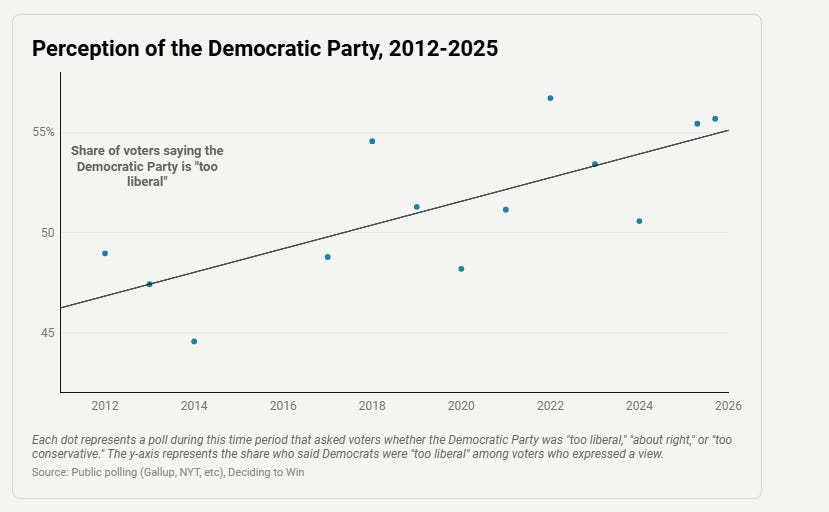
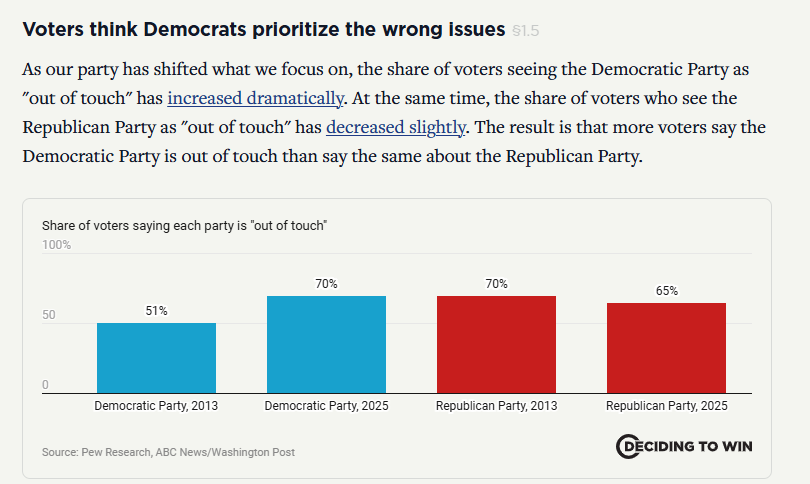
More voters now think Democrats are too liberal than think Republicans are too conservative.
If you’re wondering why the Trumpists are back in power, that’s why.
As Democrats were pushed Left by social media Republicans were quick to oblige, spending billions of dollars painting the Democrats as out of touch elitists more concerned with the rights of immigrants than America’s own beleaguered working class.
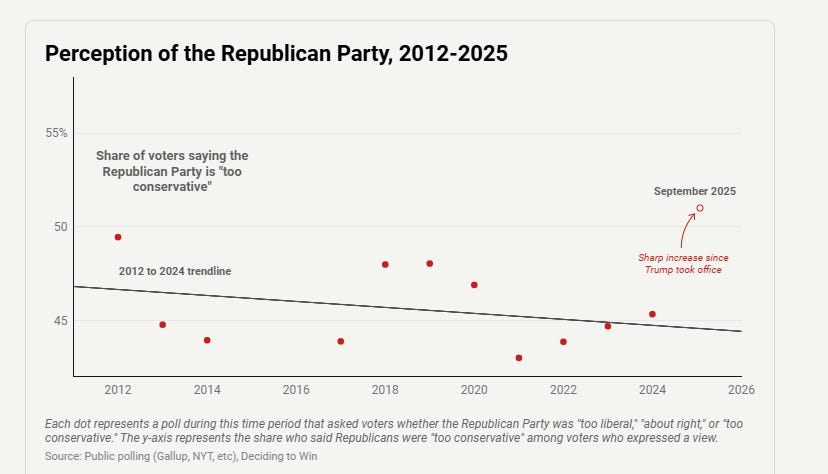
Consider the Republican Party’s graph and keep in mind that the time period mapped saw the old guard GOP primaried to extinction or appeasement by MAGA.
This is despite the Big Lie and the even bigger coup attempt!!
The Problem Is Our Lack of Narrative
Deciding to Win is solid in its findings that the Democratic Party’s pursuit of Obama era identity-based messaging as ostracized it from its historic working class base, but just talking more about economic issues will not be enough, its how they are talked about that will determine our party’s future.
The irony is, Democrats are the party that built modern America’s middle class. The liberal project—the New Deal through the Affordable Care Act—was a smashing success. We built Social Security. We built Medicare. We rescued the economy twice in fifteen years.
But no one knows that, because we don’t tell it like a story.
We talk about “policies.” They talk about villains.
They tell you who ruined your life and who’s coming to fix it. We tell you we’re “investing in communities.”
Our messaging is safe, sanitized, and soulless. It’s the difference between a warning label and a movie trailer.
Talking About Affordability Without a Villian is Pointless
Take Gretchen Whitmer’s recent appearance—textbook consultant polish. When asked about the White House’s East Wing demolition, she stayed “on her economic message.” She said she’s “focused on jobs and growth.”
And that’s the problem. It’s all positive, dry bullshit with no hero/villain narrative.
There’s no villain, no stakes, no emotion. It’s what happens when Democrats mistake “discipline” for “deodorant.” It covers the stink without fixing the infection.
Real message discipline isn’t about saying the same safe line and staying on topic—it’s about deploying and repeating a frame that hits emotionally.
You can’t sell “I’m focused on the economy” to a voter who hates the economy. You have to explain why they hate it—and who made it that way.
The Negative Partisanship Fix
What Deciding to Win gets right is that we have to rebuild the economic brand.
What it doesn’t understand how to do it right.
In a two product market you don’t fix a brand with a new slogan—you fix it with a new villain. With a narrative.
Because here’s what human psychology tells us: people don’t act for ideas, they act against threats.
So when we talk about the economy, we can’t just say “Democrats will make it better.”
We have to say:
“Republicans broke it.”
“Trump’s tariffs are a tax on you.”
“They give to billionaires and take from your pocket.”
“They’re the reason your kid can’t afford rent.”
Every message must define the villain, then introduce the hero.
Villain, hero. Problem, solution. Pain, relief.
That’s how brains process politics. That’s how we win.
The Path Forward
So yes, it’s a tough Rx from the doc. But it’s medicine we’ve needed for a long time.
After a year and millions of dollars, Deciding to Win proves in data what I’ve been arguing all year: Democrats have a massive brand problem that only good marketing and negative partisanship can fix.
We are not the party of the working class in people’s minds because we stopped sounding like it.
We are not the party of strength because we stopped fighting like it.
We are not the party of freedom because we stopped claiming it.
Now we have the receipts. Let’s use them to start fixing what’s broken—not with platitudes, but with purpose.
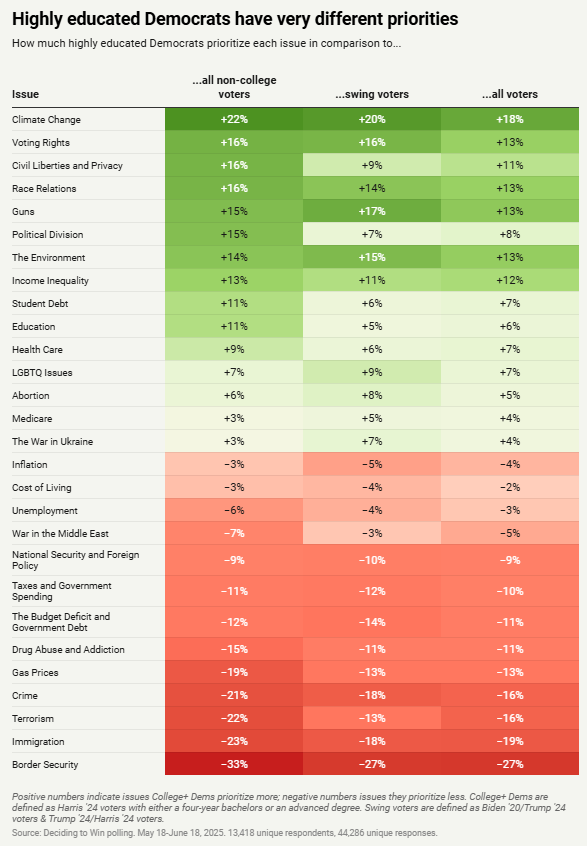
When I say we are highly educated White liberals making messaging that only appeals to other highly educated White liberals- by FAR the most liberal component of the party’s base-this is what I mean:
But again, even if every Democrat on the ballot is laser-focused on economic issues, it is still not enough. Our messaging has to perform two duties: our brand up and their brand down.
And Trump’s tariffs and betrayal on lowering process is the perfect wedge with which to start this rebranding work. It is campaign malpractice to run on affordability without blaming high prices and a shitty economy on the party in charge.
Deciding to win will take more than a shift in issue emphasis and moderation on crime and immigration, it requires a complete revolution of our paid ad strategies in the swing races across the map in time for 2026.
It is to this goal I remain hopelessly committed.
Rachel, I’m a longtime fan of your work and the urgency you bring to Democratic messaging, but I wonder if this piece might be missing the forest for the very dysfunctional trees.
The idea that branding alone can rescue a party losing ground with working-class voters of all backgrounds feels… dangerously partial. Yes, Democrats are flailing on economic messaging. But isn’t part of that failure structural, a media ecosystem owned by billionaires, a political map twisted by gerrymanders, a Supreme Court that gutted the Voting Rights Act, and a constant background hum of right-wing disinformation that scrambles perception itself?
To put it more bluntly: It’s not just that we lack a villain, but that our villains bought the building, wrote the script, and now we’re arguing over line delivery while the roof’s on fire.
I wrote about this broader problem, how centrist delusion and institutional rot got us here, and why the obsession with swing-voter messaging ignores the deeper fractures in American democracy. It’s not enough to rebrand the Democrats if the system itself is rigged against rational persuasion.
Here’s my piece:
https://www.stewonthis.com/p/the-real-culprits
And there is an obvious villain; the billionaires who are stealing everything that isn’t nailed down while we fight about trans athletes.