
Democracy on Autopilot
America expanded the right to vote without building the civic culture democracy requires

This week brought another round of buried headlines declaring that Americans don’t understand their own government.
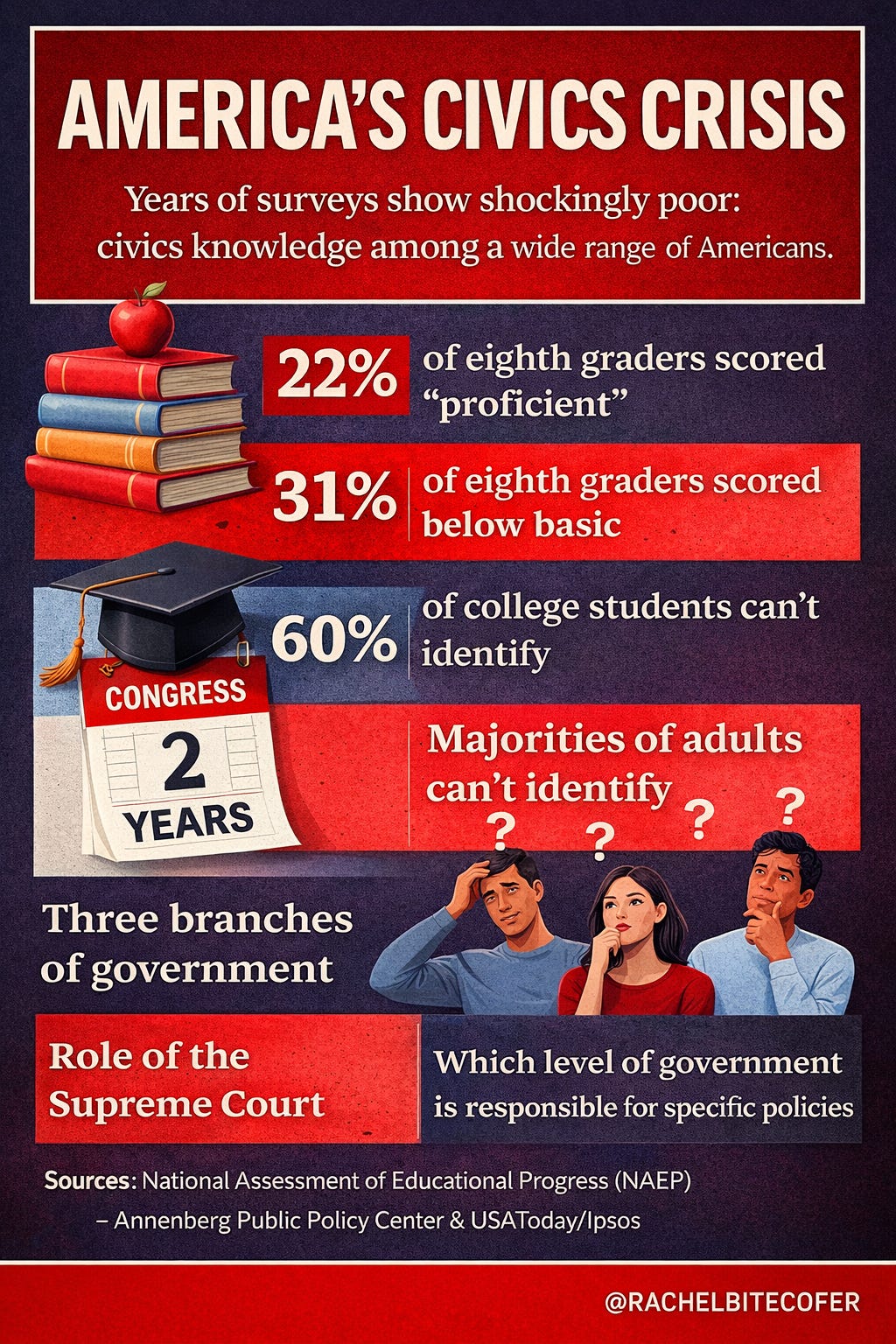
The latest national civics assessment shows just 22% of eighth-grade students scoring “proficient” in civics, while roughly 31% fall below basic competency. Surveys of college students find that about 60% cannot identify the term length of members of Congress, and adult civics quizzes routinely show large shares of Americans unable to answer basic questions about how the federal government works.
On social media we are seeing one common theme from foreigners:
WTF is wrong with you, America?!
To which I am forced to reply with the sad reality that most Americans have still no idea that any of this is even happening.
No, really. Go out in the world. Do you a get a sense people realize they are living through what is shaping up to be a historical clusterfuck of epic proportions. One commentator said the guy behind him in line at the airport didn’t understand why the TSA lines were so long, so he told him its from the shutdown.
Dude said “what shutdown?!”
Watch Good Morning America and you would never know anything is wrong. Few Americans watch news of any type, but when they do, they watch “news” that would be in the culture section in any other country.
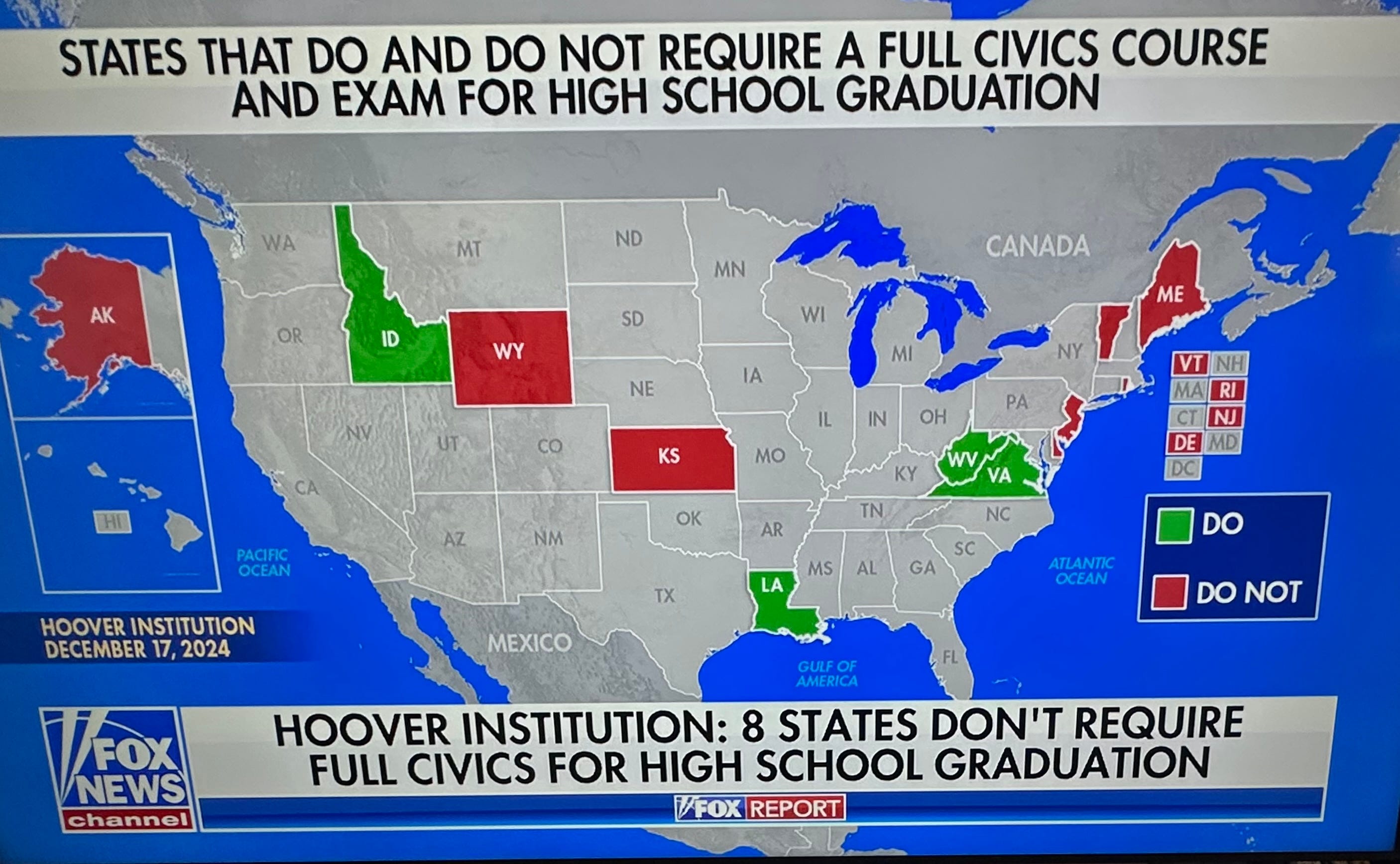
Every time new data drops that reconfirm old findings about America’s civic crisis, the reaction is always the same: hand-wringing and a call for more civics classes. The fact is, just 5 states fail to mandate K-12 civics and yet 60% of America adults still don’t know the House of Representatives is a 2 year term, so increasing access to civics in the remaining states ain’t gonna fix it.
Here’s why. When I give speeches, I often tell a story about one of the most famous studies in political science.
In the late 1950s and early 1960s, once telephone surveys became feasible, a group of researchers at Columbia University set out to answer a deceptively simple question: What do American voters actually know about politics?
The result was the landmark study The American Voter by Angus Campbell, Philip Converse, Warren Miller, and Donald Stokes. Long time readers have read stuff about this book before.
What they found shocked the academic world.
Aside from knowing who the president was and having vague impressions about what Democrats and Republicans stood for, most voters knew almost nothing about how their government worked. They struggled to identify policy positions, rarely understood institutional roles, and often couldn’t connect political decisions to real-world outcomes.
The American Voter left no doubt that the average voter was not the rational policy analyst imagined in civics textbooks, but a low interest no nothing voting on vibes and party brands.
And that was sixty years ago.
In other words, the American voter today still looks remarkably similar to the voter described in The American Voter.
But something important has changed. The world around that voter has become vastly more complicated. When the United States was founded, the political system was relatively simple.
The federal government was small. Most policy decisions occurred locally. The economy was largely agrarian. Political information traveled slowly, and like now, was full of propaganda, but the men founding the Republic were highly educated and erudite.
Today the opposite is true. Modern government manages seriously complex shit and yet we are putting people like Lauren Boebert in charge. Understanding even a single policy issue can require navigating layers of bureaucratic authority and technical expertise and instead of electing smart, educated people prepared to deal with these complexities, the GOP elects high school drops outs who consider ignorance a strength and believe Ivermectin cures cancer.
Over the nineteenth and twentieth centuries, voting rights expanded from a narrow property-holding, highly educated elite to the entire adult population of citizens. That expansion was morally necessary, but the United States expanded suffrage much faster than it expanded the civic infrastructure needed to sustain it in a highly complex and instant global information system.
The Digital Era has weaponized low civic knowledge and brought America to her knees in what can only be called national suicide.
The founders worried about this
The founders were not democrats in the modern sense. Many feared what they called “mob rule.”
Figures like James Madison argued in The Federalist Papers that public opinion needed to be filtered through institutions. The Constitution built in buffers — staggered elections, the Senate, the Electoral College, and an independent judiciary — partly because they assumed political knowledge would be uneven.
But another founder, Thomas Jefferson believed the long-term solution was education. A republic could only survive if citizens were educated enough to govern themselves.
Jefferson understood something we often forget today:
Democracy requires civic capacity.
And civic capacity doesn’t appear automatically.
It has to be built.
The real problem is our political culture
The deeper issue is cultural. The United States has developed a political culture that treats civic engagement as optional.
Americans routinely say things like:
“I don’t follow politics.”
Or worse:
“I’m proud I don’t follow politics.”
Politics determines taxes, war, healthcare, education, infrastructure, and civil rights, yet large numbers of Americans treat political awareness as a hobby they can leave to others rather than a personal civic responsibility to maintain and grow democracy.
Even more troubling, many disengaged citizens view themselves as morally superior to those who participate.
The digital revolution made the problem worse
The industrial revolution introduced complexity into a previously agrarian society. The digital revolution has done the same today — only faster.
Modern voters must navigate:
algorithmic information feeds
partisan media ecosystems
disinformation campaigns
endless streams of political content
The result is a dangerous paradox.
Many Americans now hold strong political opinions about issues they barely understand. Others disengage entirely while still judging the system from the sidelines. Neither condition produces healthy democratic decision-making.
Democracy requires civic maintenance
Democracy is not a self-running system, it depends on citizens who pay attention, understand basic institutions, and accept and adhere to democratic norms. Historically, those habits were reinforced through families schools, civic organizations, unions, community groups, and trusted news institutions.
Many of those institutions have weakened or disappeared.
Fixing democracy means fixing the culture
Civics classes are a start, but democracy ultimately depends on a cultural expectation that citizens take active responsibility for their government.
That means sustained civic education, a healthier information environment, and social norms that treat civic awareness as a duty rather than a hobby.
Because democracy doesn’t fail simply because people disagree, it fails when citizens are too dumb to maintain it.
“Politics determines taxes, war, healthcare, education, infrastructure, and civil rights, yet large numbers of Americans treat political awareness as a hobby they can leave to others rather than a personal civic responsibility to maintain and grow democracy.” Which is why I hate that people are so proud to say “we don’t talk about politics or religion”. Religion I get. Saying you don’t talk about politics is part of the reason we are in this mess. If you aren’t talking about politics you aren’t discussing the issues that affect people every day. It’s a moronic thing to say. And it’s what has helped get us to such a polarized state because “I don’t talk about politics” has become “I no longer know how to talk about politics.”
This is my answer to those who boast of their indifference to politics and dislike of polticians: "Well, they love people like you, because they take and spend your money and you don't pay any attention to what they do."