
It’s a Trap!
The SAVE Act was designed to fail—so Republicans can claim elections are rigged when they lose

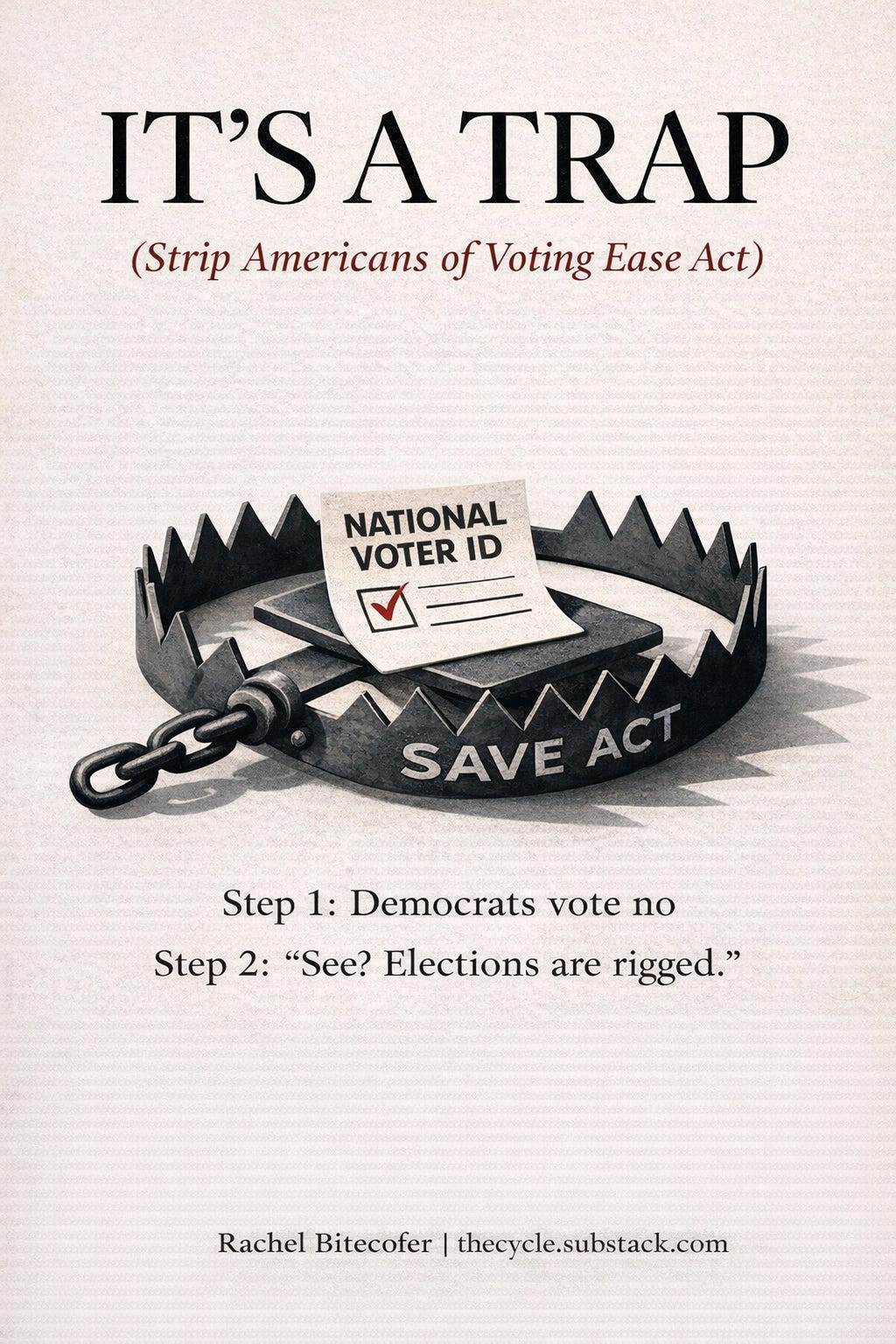
I can’t state this any plainer. The SAVE Act is a political trap. It was designed that way.
If we were being honest about what the bill actually does, the acronym would stand for Strip Americans of Voting Ease Act because that is exactly what the legislation is designed to do.
Much of the recent coverage of the SAVE Act has focused on the mechanics of the proposal—documentary proof of citizenship requirements, changes to voter registration rules, and a series of additional election restrictions. But treating the bill as a straightforward policy proposal misses the larger political strategy behind it.
It is no mere “national voter ID law” as media seems to insist on framing it.
The SAVE Act was never written to become law. It was written to produce inevitable no votes from Democrats to build a narrative to reject the results of 2026 and 2028.
Specifically, the SAVE Act is a bill Democrats have no choice but to oppose, filled with crazy shit like needing passports to vote and ending vote-by-mail. And that vote against what Republicans claim is just a national voter ID law then becomes the evidence Republicans need to claim that Democrats oppose voter identification so they can cheat.
In other words, the no vote is the point.

The Politics of Friction
Political scientists have known for decades that the rules governing elections shape turnout. When voting becomes easier, more people participate. When voting becomes harder, participation declines.
That relationship is one of the most consistent findings in the study of American elections. Participation is not simply a reflection of enthusiasm, competition, or civic virtue; it is also a function of institutional design.
Over the past fifteen years, Republican-controlled legislatures across the country have steadily rewritten those rules. They have shortened early voting periods, tightened registration deadlines, limited absentee voting options, reduced polling places, and introduced additional documentation requirements.
None of these changes individually prevents people from voting outright. But taken together, they raise the cost of participation.
And when the cost of participation rises, turnout falls.
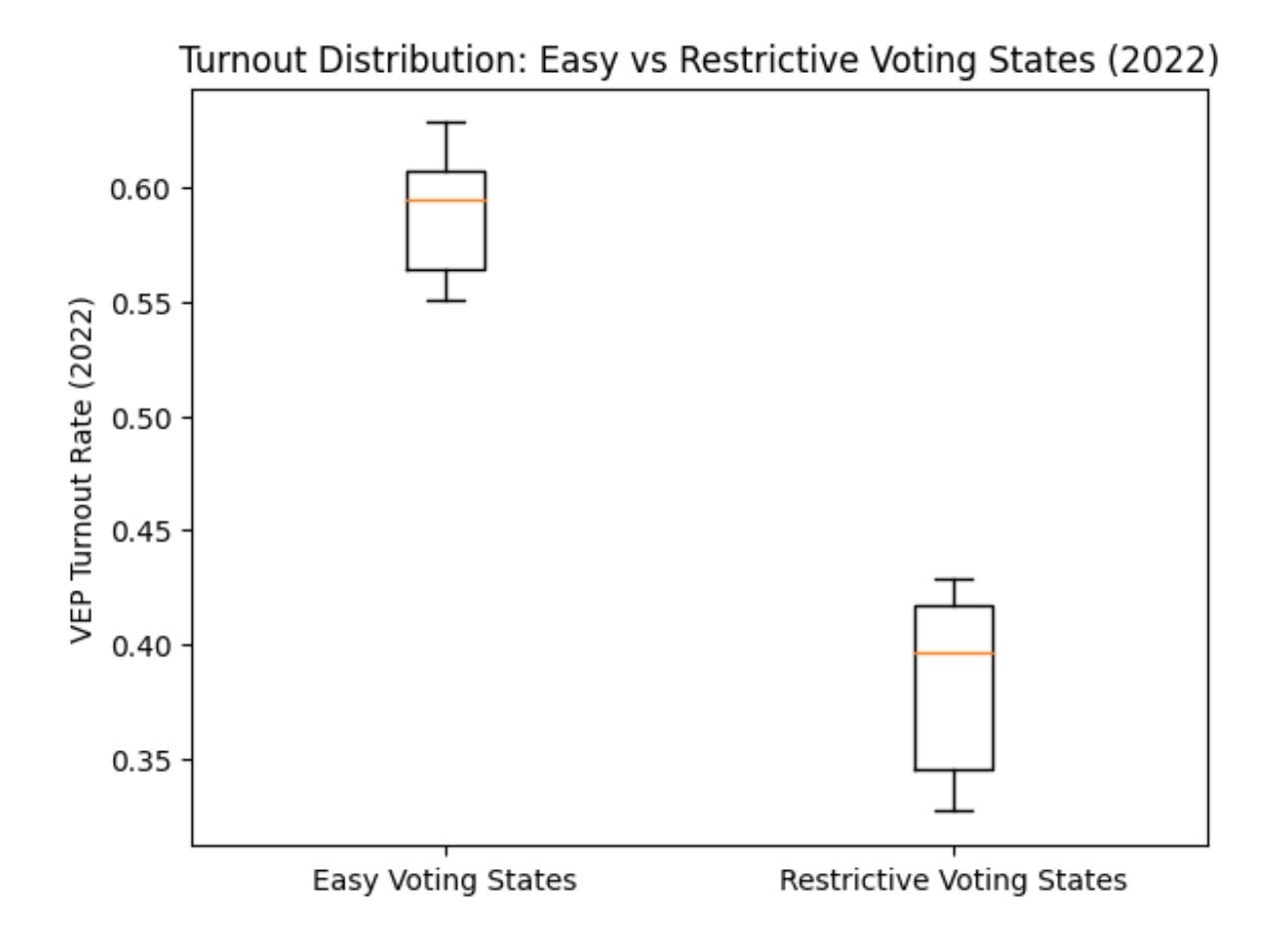
The Geography of Turnout
You can see this relationship clearly when comparing states that have made voting very easy with states that have made it very hard.
In states such as Oregon, Washington, and Colorado, voting is integrated into everyday life. Every registered voter automatically receives a ballot in the mail weeks before Election Day. Voters can fill out the ballot at home at their leisure and return it by mail or deposit it in widely available drop boxes. There are no polling places. The registration and signature verification systems ensure ballots are secure without requiring voters to navigate complicated bureaucratic procedures. When non-citizens were accidentally registered to vote in the state’s new automatic voters registration process, the system flagged the issue and steps were taken to resolve it.
Not surprisingly, vote-by-mail states consistently produce some of the highest voter turnout rates in the country and that is why the SAVE Act seeks to make it illegal despite more than 30 years of secure vote-by-mail elections. Indeed, absentee, early voting days, and vote-by-mail were all reforms Republicans championed and until Donald Trump made up his Big Lies about them, Republicans were just as apt to vote by mail as anyone else.
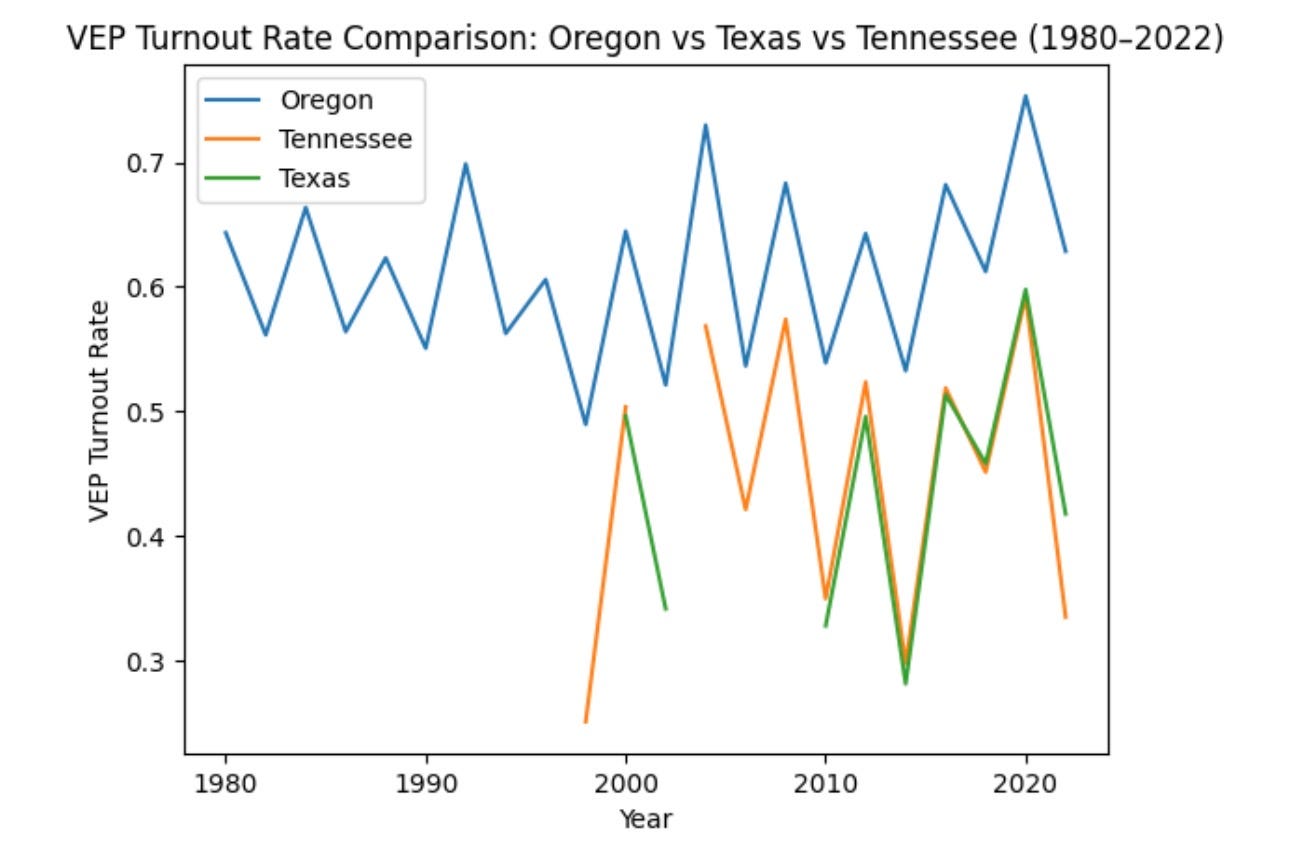
Now compare that experience with states like Texas, Mississippi, or West Virginia. In those states, voters often face stricter registration deadlines, fewer absentee options, and a more complicated voting process overall.
The result is predictable. Those states routinely produce some of the lowest turnout levels in the United States.
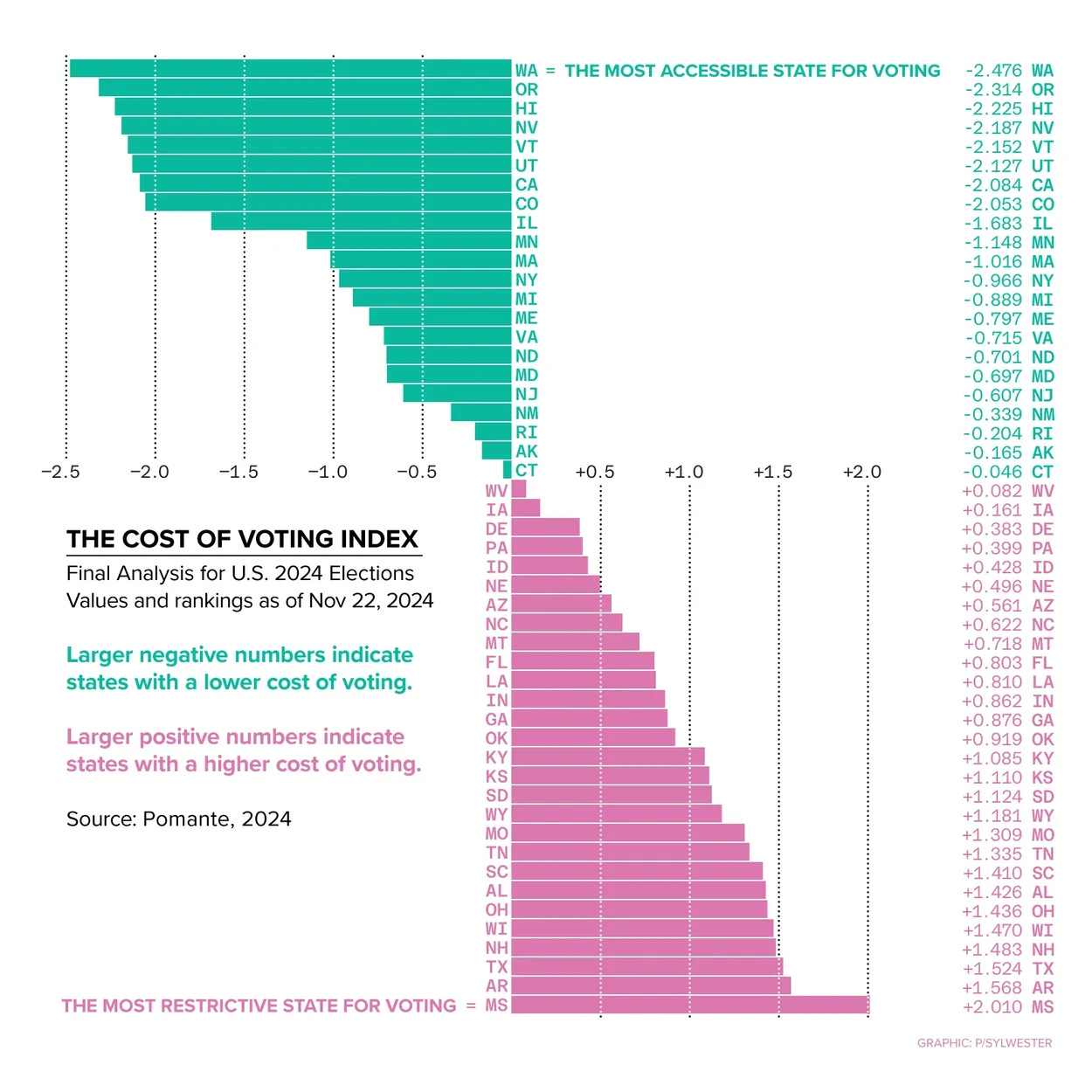
This pattern is not mysterious. It reflects a series of institutional choices about how easy—or how difficult—it should be for citizens to participate in elections.
Registration Is One of the Biggest Barriers
Voting access is not only about how ballots are cast. It is also about when voters are allowed to register.
In many states, voter registration closes weeks before an election—sometimes nearly a month before Election Day. The problem is that most Americans are not thinking about elections that far in advance.
In fact, many voters do not even realize there is an election until the last the final weeks, when media coverage intensifies and the election becomes difficult to ignore. By that point, however, registration deadlines in many states have already have passed.
In practical terms, that means the election is effectively over for millions of otherwise eligible voters before they even realize it is happening.
SIDE NOTE: If you wonder why this graph has so many peaks and valleys it is because it is documenting voter turnout in both presidential elections (peaks) and midterm cycles (the valleys). It is useful to underscore a really important point I want everyone focused on which is that many betrayed Trump voters have never heard the words “midterm election.” They do not realize elections exist every two years and not just every four years. Tell people about the 2026 midterms- do not assume they know it exists.
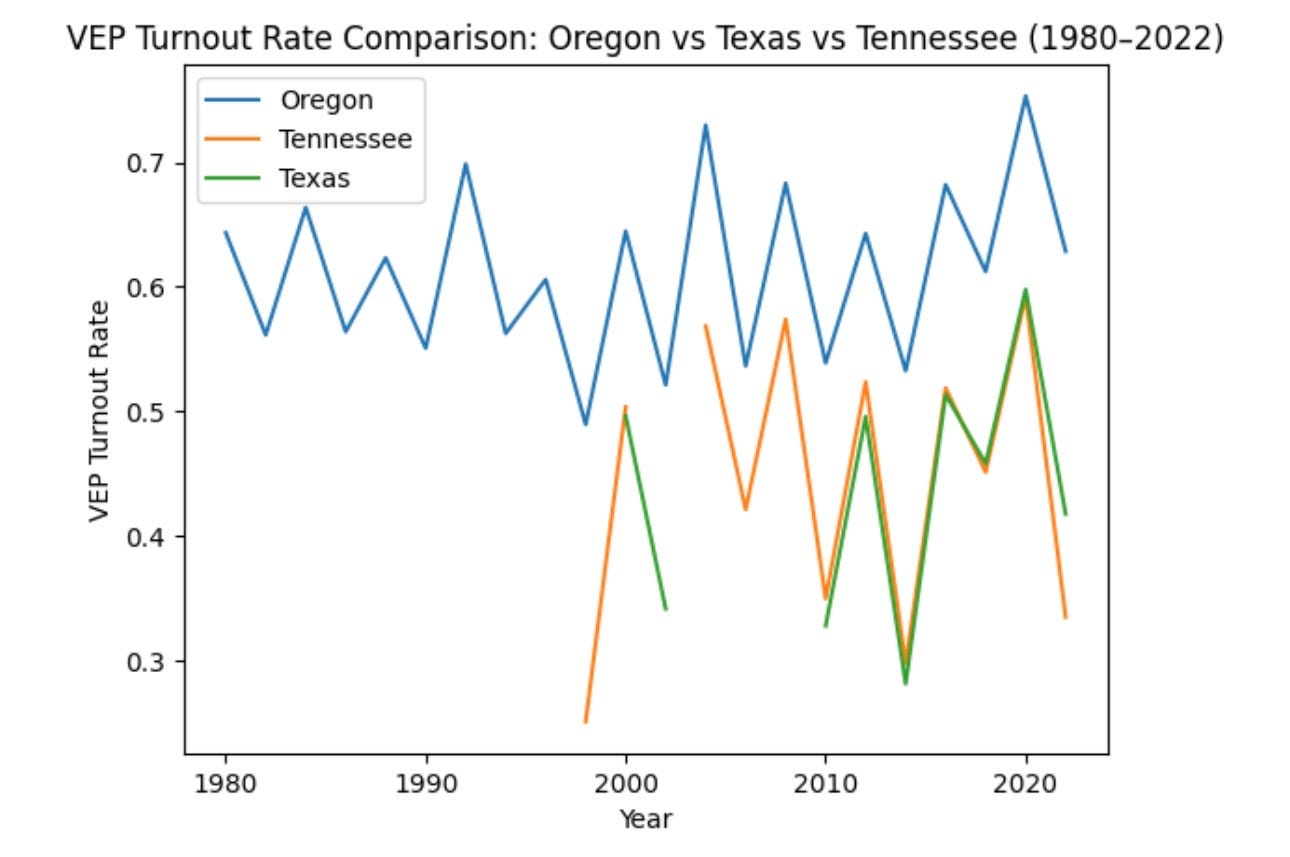
Some states improve participation rates through same-day voter registration, allowing citizens to register and vote at the same time. States such as Minnesota, Wisconsin, and New Hampshire have used this system for years, and they consistently produce some of the highest turnout levels in the country.
Remove the registration barrier, and participation rises. Leave the barrier in place, and participation falls.
Most Americans Aren’t Paying Attention Yet
Political professionals often assume that voters follow politics closely because campaigns, advertisements, yard signs, and engaged people dominate their own professional environment. But research consistently shows that this assumption is incorrect.
Studies conducted by the Knight Foundation have repeatedly found that large numbers of Americans pay little attention to political news for most of the year. Many voters only begin focusing on an election during the final stretch of a campaign. Most say they don’t vote not for lack of access but for lack of interest.
That timing matters enormously.
If registration deadlines occur weeks before Election Day, millions of otherwise eligible voters may already be locked out of the system by the time they even realize an election is underway. This is especially true among younger voters.
This dynamic is particularly important in midterm elections, which receive far less sustained media attention than presidential contests. For many citizens, the moment they realize there’s an election is the same moment they discover that the registration deadline has already passed.
Who Actually Navigates Voting Barriers
Administrative hurdles do not affect all voters equally.
Highly engaged voters—people who follow politics closely and participate in elections regularly—almost always find a way to navigate new rules. As do ideologies and hard core partisans. If requirements change, they adapt. If additional documentation is required, they obtain it. If deadlines move earlier, they register earlier.
In other words, the voters most likely to overcome new bureaucratic hurdles are those who are already the most politically engaged and socially advantaged.
The voters most likely to be filtered out by administrative barriers are those on the margins of participation. These are citizens who might vote if the process is straightforward but who do not follow politics closely enough to track every procedural requirement. Less Independents vote in midterms.
Voting rules rarely stop the most motivated voters. Instead, they determine whether millions of occasional participants are able to participate at all.
What the SAVE Act Would Actually Do
Much of the media coverage surrounding the SAVE Act has described the legislation as a “national voter ID bill.” That framing obscures what the bill actually contains and is proving a good assist for Republican efforts to set their fall narrative of fraud.
The bill would require documentary proof of citizenship in order to register to vote, but that is the only thing it shares with the other 36 voter ID laws already in practice in the states. What makes the SAVE Act so radical is that a driver’s license is now longer accepted, not even REAL IDS- which cannot be obtained without proof of citizenship.
Roughly half of Americans do not possess passports. Obtaining one costs money and time, and resolving documentation discrepancies can add additional complications. For example, many married women use a last name that differs from the one listed on their birth certificate, requiring additional paperwork to reconcile identity records.
None of this makes voting impossible.
But it does make voting much harder.
And when voting becomes harder, turnout declines.
The Political Function of the Bill
Lower voter participation is not the only purpose the SAVE Act serves. The legislation also functions as a political messaging tool.
Since 2020, Donald Trump has convinced tens of millions of Americans that U.S. elections are riddled with fraud. The evidence says otherwise. The 2020 election was audited repeatedly across multiple states—including states where Republicans controlled the process—and those audits consistently found virtually no evidence of widespread fraud.
But narratives do not require evidence. They require repetition.
Every time the SAVE Act is described as a “national voter ID bill,” that narrative gains strength. And every time Democrats oppose “national voter ID,” Republicans gain another opportunity to claim that Democrats are resisting election security.
In this sense, the legislation functions not only as a policy proposal but also as political messaging infrastructure for later.
The Strategic Countermove
There is a straightforward way Democrats could use to defuse this tactic and more importantly, undercut Trump’s plan to stay in power based on lies about election fraud after Republicans lose the 2026 and 2028 elections.
Democrats should seize this opportunity to call the bluff.
Democrats should insist on a clean voter identification bill stripped of the additional restrictions embedded in the SAVE Act. Such legislation could include multiple acceptable forms of identification, free government-issued IDs for voters who need them, and accessible verification systems. This was already put forward by Democrats as a “carrot” in the John Lewis Voting Rights Act.
Given that even 71% of Democrats support “showing an ID to vote” Schumer and Jeffries, should counter offer Republicans a clean voter ID bill and force their hand.
This would put them in a position where they either accept reasonable legislation that will undercut their ability to claim fraud OR vote as a party against national voter ID.
And the good news is that clean national voter ID bills even have majority support among the very demographic groups Democratic activists claim would be hurt (by normal voter ID requirements).
At the moment, Republicans benefit from a simple talking point: that Democrats oppose voter identification because they want to cheat.
A clean bill would force Republicans to choose.
Either enact a straightforward voter identification law—or admit that voter ID was never the real issue.
Because the Vote Was the Point
The SAVE Act however, is not what was polled here. What was polled was the general concept of requiring voters in all states to show ID.
The SAVE Act was never designed to produce a bipartisan compromise. It was written to produce a vote that Democrats would be forced to oppose and polling like this that makes it look as though what Democrats are voting against is super popular. That narrative will then serve as the foundation for future claims that elections cannot be trusted.
In that sense, the legislation is less about election security than about preparing the narrative for the next contested election.
The bill was written so that Democrats could not support it.
Because the vote itself is the point.
And the SAVE Act ultimately serves a much larger political purpose: creating the conditions under which the next election loss can once again be declared illegitimate.
Dems supporting a clean version of this bill makes so much sense! Schumer and Jeffries just need to go. Thanks for this enlightenment.
I have written my representatives and the Democrats’ leadership and suggested they get in front of the issue by demanding the government issue a national ID card free to citizens.
It wouldn’t be difficult to convert the social security card into a national ID card. When you turn 18, you have your photo taken and they issue a secure photo SSC.
The Dems have the most pathetic, inept messaging and they repeatedly fall prey to GOP talking points. It’s very disheartening.