
The Messengers
These Democrats Are Moving the Democratic Party into the Future

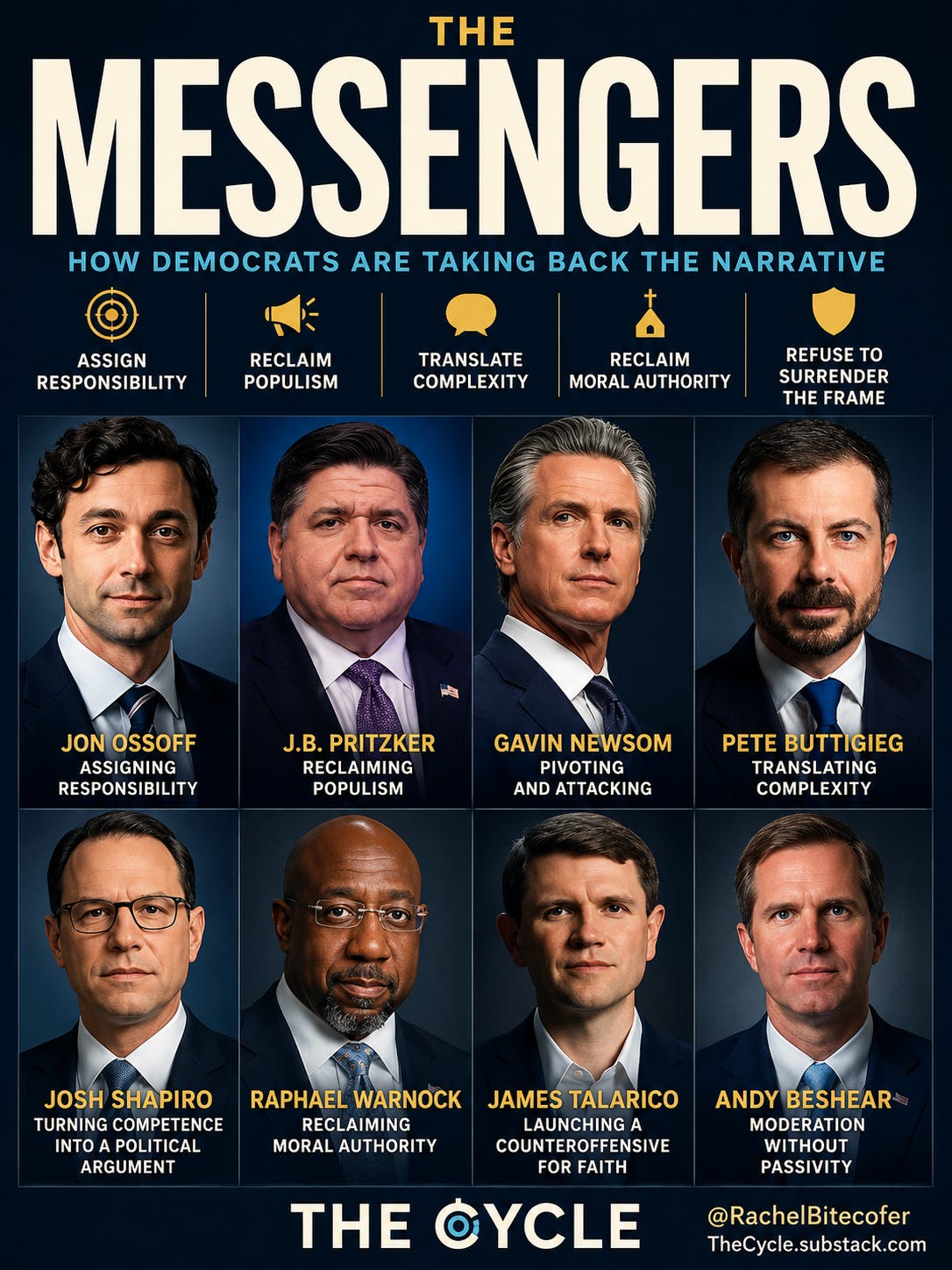
The Messengers
For years, Democrats have been told all they need to win elections are better policies, better plans, better white papers, and better issue positions. The assumption has always been that if Democrats could just explain their wonky ideas enough, voters would eventually come around.
But politics doesn’t work that way. If you’re explaining, you’re losing.
Most voters aren’t reading policy papers. They aren’t studying legislative proposals- they don’t even know there is a state legislature! Voters in 2026 and 2028 are trying to answer a much simpler set of questions:
Why is life so expensive?
Who caused it?
Who is fighting for people like me?
And who is standing in the way?
The politicians who are breaking through in this environment understand that those questions matter more than any policy briefing ever will.
Consider this group, which is not meant to be inclusive of all effective communicators in the party: Pete Buttigieg, Jon Ossoff, James Talarico, Gavin Newsom, J.B. Pritzker, Andy Beshear, Raphael Warnock, and Josh Shapiro. They come from different regions. They represent different constituencies. Some govern deep-blue states. Others operate in some of the toughest political terrain in America. Most have obvious presidential ambitions. All of them must communicate beyond their political base to win over swing voters.
What’s important about this group is not that they are ideologically identical, they aren’t. What’s important is that they have figured out how to communicate. More specifically, they have figured out how to communicate in a political environment where attention is scarce, trust is low, and voters are looking for someone to explain who is responsible for the problems they face. The reform movement in Democratic politics is no longer theoretical, it has practitioners.
Assign Responsibility
Since Trump’s inaugural some Democrats have spoken about affordability as though it were a random force of nature and not personally caused by Donald Trump and his Republican enablers via tariffs, trade wars, and now gas inflation from the Iran War. Prices are rising after Trump promised to lower them on Day One.
But voters do not experience affordability as an abstract economic condition, they experience it as a consequence. The question they are asking is simple:
Why is the rent too damn high?!
Georgia Senator Jon Ossoff’s communication is effective because he answers that question (and if I dare say, and you know I dare, he’s a total hottie.
Rather than treating rising costs as an unavoidable fact of life, he connects those costs directly to political decisions. Rising healthcare costs, economic uncertainty, tariffs, and other pressures facing Georgia families are not merely unfortunate developments. They are the result of choices made by Donald Trump and Republicans in Washington. That is not merely a policy argument, it is a partisan argument amd that distinction matters.
Politics is ultimately about assigning responsibility. Parties build their brands by claiming credit for what voters like and assigning blame for what voters dislike. Republicans spent decades telling voters that Democrats were responsible for the problems they faced. Whether discussing taxes, inflation, crime, immigration, or government spending, Republicans consistently connected problems to a political actor.
Democrats have often been far less willing to do the same. Ossoff does not make that mistake. When he talks about affordability, he does not simply describe rising costs. He identifies who made the decisions that produced those costs. He draws a direct line between political choices and economic consequences. Ossoff is not merely describing a problem, he is assigning responsibility for it where it belongs and where it must be placed for Democrats to take over the GOP’s undeserved brand as good for the economy.
Ossoff is a case study in the difference between explaining politics and competing in politics.
Reclaim Populism
Somehow Democrats allowed Republicans, the party of billionaires, to portray themselves as anti-establishment champions of ordinary people while simultaneously governing on behalf of wealthy interests and large corporations.
Again, that’s weird! We are the only western democracy where working class people are voting for the party of Big Business. Politicians like J.B. Pritzker and Gavin Newsom refuse to concede that terrain.
Pritzker has been particularly effective because he occupies a role Republicans traditionally claim for themselves. As a billionaire, he is uniquely positioned to challenge the idea that wealth and virtue are synonymous.
In that sense, his politics often feel less like modern Democratic technocracy and more like the Theodore Roosevelt tradition of American populism. Roosevelt did not argue that wealth itself was the problem. He argued that concentrated power was. He worried about economic systems becoming so tilted toward powerful interests that ordinary citizens could no longer compete on equal terms.
Pritzker is making a remarkably similar argument. The strategy is to channel the natural anger in the electorate and assign blame to Republicans for a system that increasingly rewards those who already possess wealth, influence, and political power while asking everyone else to absorb the costs.
He is telling voters that the system did not become tilted accidentally. It was tilted deliberately, and by whom and in a presidential cycle where Democratic primary voters will be looking for someone to save them, Pritzer offers voters this:
Newsom as smooth as butter at his signature skill, pivot and attack. Newsom never accepts the frame he’s given. When opponents want to talk about culture-war controversies, Newsom pivots to freedom. When opponents attack Democratic governance, he pivots to contrasting outcomes between Red and Blue states. When opponents claim Republicans represent ordinary Americans, he asks who is actually benefiting from Republican policies.
He doesn’t merely participate in political debates, he redefines them and is leading the charge on effective use of social media and the massive audiences that live on You Tube. That is why he has become one of the party’s most effective national communicators. He understands that political arguments aren’t won through detailed policy explanations, they are won via narrative warfare.
Translate Complexity
Pete Buttigieg and Josh Shapiro both demonstrate another skill that has become increasingly important in modern politics, translation of complex shit:
One of the enduring weaknesses of Democratic communication has been the tendency to speak in SAT level policy language voters can’t even understand. Voters do not spend their days thinking about legislative frameworks, regulatory structures, appropriations formulas, or administrative processes. They think about whether they can afford groceries. They think about whether they can afford rent. They think about whether their children will have opportunities.
The best communicators understand how to translate complicated policy debates into stories that connect directly to those concerns. What makes Buttigieg particularly effective is that he does not stop at explanation, he assigns responsibility.
Again and again, interviewers attempt to pull him into technical discussions or ideological debates. Rather than remaining trapped there, Buttigieg redirects the conversation to his own frame:
A discussion about Iran makes it clear that Trump fucked up. A discussion about tariffs becomes a discussion about higher prices that blames Trump. A discussion about infrastructure becomes a discussion about jobs and economic opportunity that blames Trump. A discussion about government becomes a discussion about who made the decisions affecting people’s daily lives and blames Trump. He understands that voters are not merely asking what happened, they are asking why it happened and who is responsible for it?
That combination is powerful because translation without accountability often becomes a civics lesson. Accountability without translation can become a partisan rant. Buttigieg combines the two: he makes complicated issues understandable while simultaneously connecting outcomes to the political choices that produced them.
Shapiro applies the same principle from the Pennsylvania governor’s office. Rather than speaking primarily in the language of process, he speaks in the language of outcomes. Roads are repaired. Bridges reopen. Communities recover. Public services improve. What makes Shapiro interesting is that he has turned competence itself into a political argument but he does not fail to assign blame.
For years, Democrats often assumed voters would automatically reward good governance. Shapiro understands that good governance must be communicated and contrasted with it’s alternative at all times.
Like Buttigieg, Shapiro is translating complex systems into something voters can actually see and feel.
Reclaim Moral Authority
The most surprising category may also be the most important.
When I moved to Athens, Georgia, to begin my PhD at the University of Georgia, several people warned me that I was going to get invited to church. I laughed it off. Sure, I thought. Maybe once or twice.
Within weeks of arriving, I had been invited multiple times.
Given that I am a heathen, I declined every invitation but the experience taught me something important about life in the South. Church was not merely a place of worship. It was a social institution. It was a source of community. It was a source of identity. It was where people built relationships, established trust, and developed a shared understanding of right and wrong.
As someone outside that world, I quickly realized I would always be something of an outlander, a sassenach if you will. Sure, once my heathen status was well known people were still polite, but there was a cultural shunning that left me on the outside looking in socially.
That lesson has stayed with me because it helps explain something Democrats have struggled with for decades. For a very long time, Democrats treated religion as territory owned by Republicans. Warnock, Talarico, and Beshear do not.
And they are playing offense on religious faith. More specifically, they are launching a counteroffensive, seeking to remind voters that Jesus was a peace lover who mandated Christians love the foreigner and the poor. Talarico may be the most direct example of this strategy in action. It isn’t just that he’s an effective communicator of faith, he refuses to concede the morality of Christianity to the political right.
For decades, Democrats have ceded Jesus to the American Far Right. Talarico rejects that premise outright. Rather than avoiding conversations about Christianity, he enters them willingly. He challenges the assumption that Christian faith naturally points toward conservative politics and asks audiences to reconsider what values are actually being expressed.
That is what makes him such an important messenger. Talarico is not merely defending Democrats from religious criticism, he is running a counteroffensive for the hearts of Christian voters. He is reminding voters that Christianity has historically spoken to questions of compassion, service, humility, responsibility, care for the poor, and concern for the vulnerable. In doing so, he forces a comparison between those values and the political behavior being carried out in Christianity’s name.
That is not just a theological argument. Talarico is making it a political one. It demonstrates a broader lesson running throughout this article: powerful language should never be surrendered to political opponents.
And the man can pivot and attack, just watch him here:
Warnock operates from a similar foundation. As a pastor, he is uniquely positioned to contest Republican claims to moral authority. He does not merely discuss policy. He discusses values. He speaks a language that millions of Americans already understand.
Andy Beshear challenges one of the Democratic Party’s longest-held assumptions. For years, many Democrats believed that success in conservative territory required avoiding conflict and trying to pretend you are not a Democrat. The model was simple: be reasonable, be bipartisan, and above all avoid admitting you are a Democrat.
Beshear did things differently, he beat all odds to win reelection against the 2022 midterm effect by wedging abortion access. In Kentucky. Wedging abortion IN THE SOUTH!!!
Like most of the people profiled here, Beshear is not a bomb thrower. He is not a culture-war politician. But neither is he practicing the old “embarrassed Democrat” communication strategy that dominated so much of the party’s thinking up through the 2024 cycle.
When Beshear talks about healthcare, disaster relief, public education, or affordability, he does not simply describe problems. He identifies who is helping and who is hurting ordinary Kentuckians. He frames politics as a contest between people trying to improve lives and people standing in the way.
In other words, he uses heroes and villains framework. The difference is that he does so through the language of community, responsibility, and faith.
That distinction matters. For too long, Democrats confused moderation with passivity. Beshear demonstrates that the two are not the same thing. A politician can be moderate in tone, pragmatic in governance, and still be aggressive in assigning responsibility. That may be the single most important lesson establishment Democrats can learn from his success.
That said, one does not need to be running in the Bible Belt as a “bless your heart” Democrat to weaponize the GOP’s pervasion of Christianity under Trump:
Refuse to Surrender the Frame
By this point, a pattern should be emerging. Jon Ossoff assigns responsibility. J.B. Pritzker reclaims populism. Gavin Newsom pivots and attacks. Pete Buttigieg translates complexity into clarity. Josh Shapiro turns competence into a political argument. Raphael Warnock and James Talarico reclaim moral authority. Andy Beshear demonstrates moderation without passivity.
And they all do so under a hero/villain messaging framework. At first glance, these may appear to be entirely different communication styles, they are not!
They are variations of the same strategy. Each of these politicians has identified a piece of political terrain Democrats have too often surrendered to Republicans and decided to fight for it instead. Ossoff refuses to surrender responsibility. Pritzker refuses to surrender populism. Newsom refuses to surrender the battlefield. Buttigieg refuses to surrender understanding. Shapiro refuses to surrender competence. Warnock and Talarico refuse to surrender moral authority. Beshear refuses to surrender Kentucky style and values.
Different messengers, same lesson: refuse to surrender the frame.
That is the common thread running through every example in this article. What makes these politicians effective is not that they share the same ideology, the same biography, or even the same political style. What they share is a willingness to contest the meaning of the issues voters care about rather than accepting definitions handed to them by their opponents.
For years, Democrats often entered political fights on terrain chosen by Republicans. The politicians profiled here do something different. They choose the terrain themselves and force their opponents and interviewers onto it and that changes everything.
The most important lesson from these messengers is not that Democrats need more Jon Ossoffs, Andy Beshears, Gavin Newsoms, or Raphael Warnocks. The lesson is that communication is not a personality trait., it is a skill and one other Democrats can be taught.
Now, don’t think for one moment I haven’t noticed that everyone I profiled here is a man. For too long, Democrats have treated effective communication as though it were something a politician either possesses or does not possess. We talk about charisma. We talk about star power. We talk about political talent. And we particularly do so in the many women’s organizations that serve female candidates such as Emily’s List and Emerge.
Women don’t need to be trained to be empathetic deep listeners (trust me, most have that already in spades), they need to be trained for verbal combat in a male dominated space. The politicians profiled here were chosen based on merit on communication strategy AND either serving in a swing state or planning a likely presidential run and I would sure like to see more women get on board.
Democrats running new strategy repeat their messages relentlessly, select conflicts strategically, assign responsibility clearly, speak in moral language, and are focused on working “our brand up, their brand down” into every earned media opportunity they get. Most importantly, they understand that voters are looking for stories that help them make sense of the world around them. These skills can be taught
That is what makes this moment so important. For years, Democrats have debated what effective political communication might look like. We no longer have to guess. We can see it, analyze it, and most importantly, teach it. And if enough Democrats are willing to learn it, we can scale it.
The future of Democratic politics will not be determined by whether the party discovers a handful of uniquely gifted communicators. It will be determined by whether it learns to produce thousands of them. That is why these politicians matter.
Not because they are the future of the Democratic Party.
But because they are showing the rest of the party how to get there.
Where is AOC?
No women moving the party into the future?