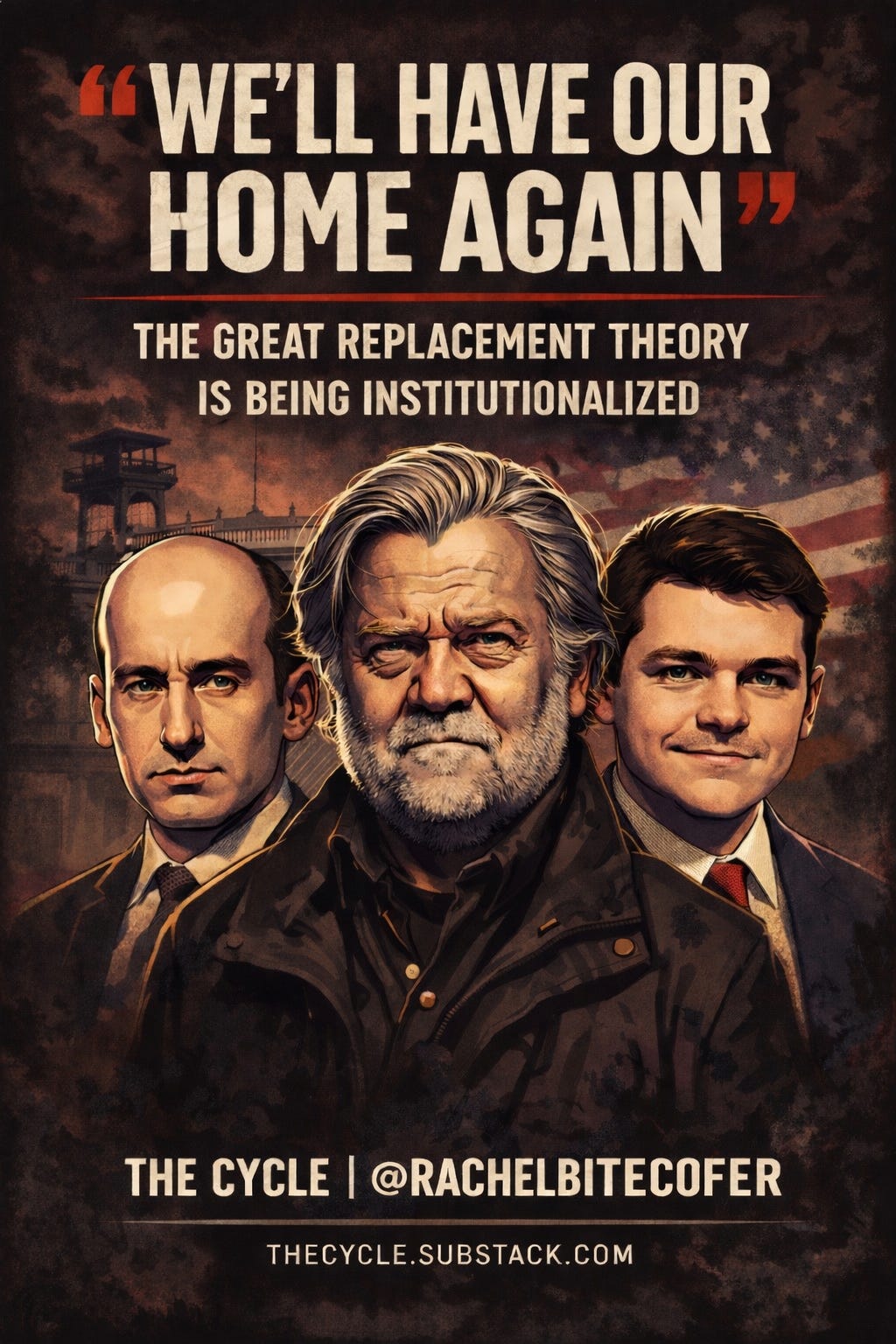
“We’ll Have Our Home Again”:
The Trump Administration is Going Full White Nationalist
Over the weekend and in the wake of the murder of Renee Good the MAGA masks came off: official U.S. government accounts promoted recruitment imagery declaring, “We’ll have our home again.”
Not as metaphor. Not as policy language. As a statement of purpose — paired with frontier imagery, militarized aesthetics, and links directing viewers to join immigration enforcement.
That phrase is not generic patriotism. It is reclamation language. And it comes with a lineage.
“We’ll have our home again” is the emotional core of Great Replacement ideology, the white nationalist belief system that frames demographic change as dispossession and recasts the nation as something that has been stolen and must be taken back. This is the same worldview that produced the chant “You will not replace us” at Charlottesville. The only thing that has changed is who is now saying it.
This time, the voice belongs to the federal government — through the Department of Homeland Security, ICE, and messaging amplified across platforms tied directly to the White House.
That is not adjacency. It is institutionalization.
What the Great Replacement Theory Actually Argues
The Great Replacement theory holds that “native” populations — implicitly white — are being deliberately replaced through immigration, multiculturalism, and demographic change. It reframes pluralism as decay and democracy as a zero-sum struggle over ownership of the nation.
This ideology is not abstract. It has been articulated explicitly by mass shooters, embedded in white nationalist manifestos, and popularized by contemporary influencers who now operate openly in American political discourse. Figures like Nick Fuentes center their politics on the claim that the United States properly belongs to a single cultural and racial group, and that reclaiming it requires hierarchy, exclusion, and force.
What makes Great Replacement rhetoric powerful is that it does not require slurs. It relies on structure: loss, invasion, restoration.
That structure is now visible in state messaging.
The Cultural Artifacts Behind “Home Again”
The phrase promoted by DHS did not emerge from nowhere. It mirrors language used in white nationalist cultural production — including the song “We’ll Have Our Home Again” by Pine Tree Riots.
That song has circulated for years in far-right spaces. Its refrain promises return and restoration through struggle — the same narrative arc found in Great Replacement ideology. Extremism researchers have documented its presence in white nationalist forums, and the Anti-Defamation League has reported that lyrics from the song appeared in the writings of the Jacksonville mass shooter.
This matters not because music causes violence, but because it shows which cultural texts circulate inside this worldview. When the government reproduces the same language, it is not borrowing from a neutral patriotic tradition. It is borrowing from a known ideological ecosystem.
The overlap here is textual, not interpretive.
From Replacement Theory to Fascist Slogans
If anyone still believes this is coincidence, the next development removes any remaining ambiguity.
An official account associated with the U.S. Department of Labor recently promoted the slogan:
“One Homeland. One People. One Heritage.”
This is not generic civic language. It is a near-perfect structural echo of one of the most infamous propaganda slogans of the twentieth century:
“Ein Volk, ein Reich, ein Führer.”
One People. One Reich. One Leader
That Nazi slogan — central to propaganda in Nazi Germany — was designed to collapse a diverse population into a single ethnic “people,” sacralize the nation as a homeland rather than a polity, and eliminate pluralism as illegitimate. Its purpose was unity through exclusion.
Modern white nationalist movements have revived this same formula precisely because it is efficient. Strip out the explicit reference to a leader, replace “Reich” with “heritage,” and the ideological work remains unchanged: the nation belongs to one people; diversity is decay; difference is betrayal.
You do not need to allege intent to recognize lineage. This is historically specific political technology, now deployed by a U.S. government agency.
A Pattern, Not a Slip
None of this is unprecedented. The Southern Poverty Law Center, through its Hatewatch reporting, has documented how DHS social media accounts have repeatedly used imagery and language that mirrors white nationalist propaganda — from visual tropes to narrative framing.
Those reports were published months ago. They were warnings.
What has changed is scale and confidence. The messaging is no longer buried or ambiguous. Multiple federal agencies are now speaking in the same ideological grammar — reclamation, unity-through-exclusion, and historical grievance.
That is how doctrine spreads inside institutions.
Revisionist History Completes the Loop
The same logic now appears in official historical narratives promoted on White House platforms, where January 6 is reframed, blame is shifted onto law enforcement, and accountability is blurred.
Great Replacement ideology requires a story in which violence is misunderstood patriotism and institutions are illegitimate obstacles to restoration. Authoritarian movements do not only rewrite laws. They rewrite memory.
When the state adopts that logic — when it treats political violence as grievance and reframes insurrection as misunderstanding — it completes the ideological loop.
What Institutionalization Looks Like
The danger here is not any single slogan or post. It is coordination and alignment.
Immigration enforcement speaks the language of reclamation. Labor messaging echoes fascist unification slogans. Executive platforms launder revisionist history. Each reinforces the same worldview: the nation is a home, it has been violated, and only forceful restoration can save it.
Institutions outlast administrations. Staff turnover does not erase doctrine.
When white nationalist rhetoric is used to recruit, to narrate history, and to define belonging, it embeds itself into the machinery of the state.
That is what institutionalization means.
Democracies do not collapse when extremists shout from the margins. They collapse when the government itself begins speaking the language of replacement, reclamation, and ownership — and calls it patriotism.


Your writings should be read by anybody thinking we can just slide through this administration untouched. It's frightening, but keep them coming.
So we have Nazis. Institutionalized. Now what?