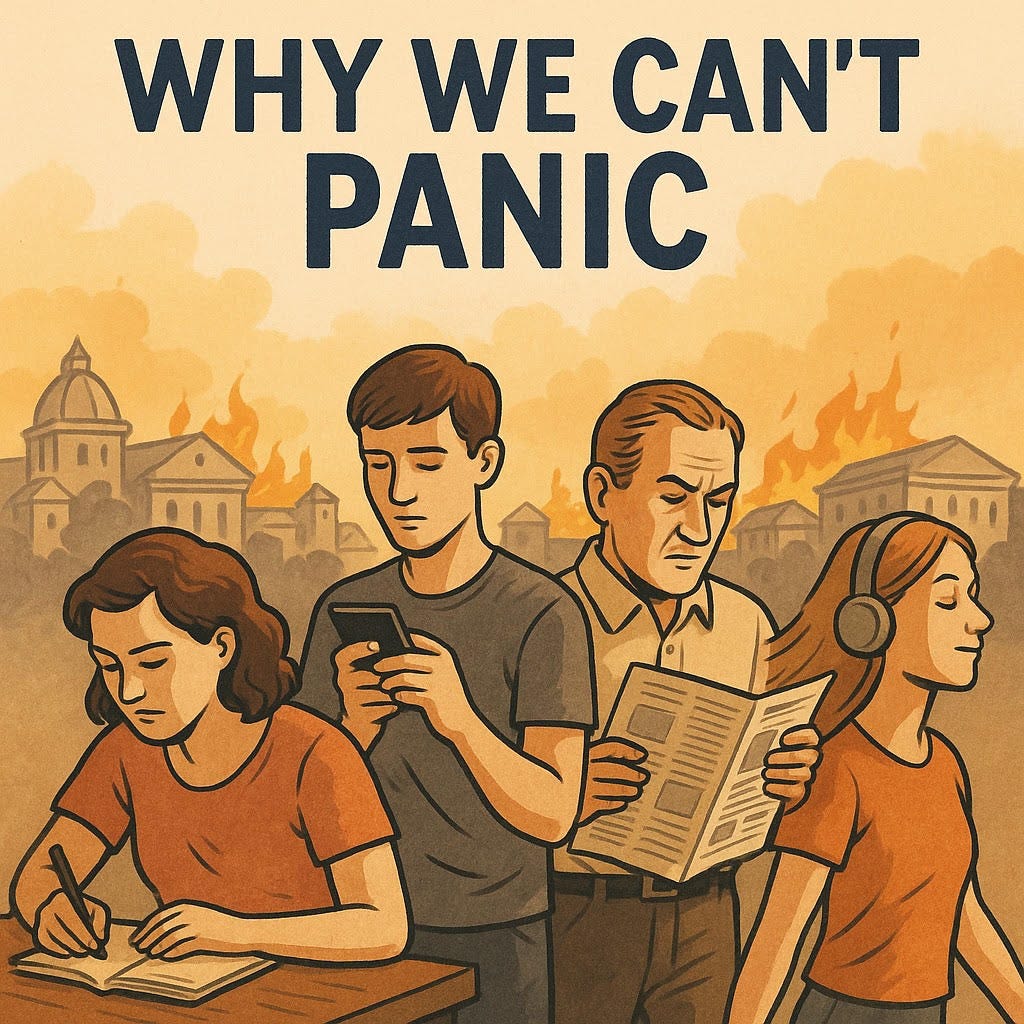
Why We Can't Panic
Humans Are Designed to Keep Calm and Carry On
Ten months into Trumpâs return to power, America feels like its full of pod people (you youngsters can go ahead and Google that one).
The FBI and DOJ have been purged and now serve as Trumpâs personal revenge machine.
The so-called âCountering Domestic Terrorismâ memorandum re-brands nearly half the countryâanyone left of MAGAâas a potential extremist threat.
Kristi Noem is on airport TVs blaming âradical liberal Democratsâ for the shutdown. The law doesnât matter. The Hatch Act doesnât matter. Nothing matters. And the public reaction is⌠nothing. I used to think the problem was informationâthat if people knew, theyâd act. Iâm not so sure I believe that anymore.
Hereâs why:
The Diary in the Dark
When I first started studying the Third Reich, I kept circling back to a single line from a Warsaw Ghetto diary.
The writer had already lost his home, his livelihood, and most of his family. He was starving in a room shared with five other families, living inside walls his own people were forced to build. Rumors were spreading that deportations east meant death, and he wrote something along the lines of
âWe hear that being deported East means they are going to kill us, but thereâs just no way the Germans would do that.â
That line told me something elemental about human nature and the unfortunate strength of optimism in our hard wiring, We are evolutionarily wired to survive what was until about 100 years ago, lives that were ânasty, brutish and short.â
When youâd spent 6 months a year freezing your balls off and eating preserved green beans while sitting in the dark after burying your 4th child, you needed a lot of capacity for optimism.
The refusal to believe what we canât emotionally survive believing is not weaknessâitâs wiring. The brain edits reality to protect itself. It lets us keep breathing inside the unbearable.
Itâs the same reason most Americans arenât in the streets right now. The mind simply cannot sustain the idea that thisâopen autocracy, political persecution, the militarization of domestic policingâmight actually be happening here. So it files the terror away under âpoliticsâ and scrolls on.
The Biology of Denial
Panic feels irrational, but itâs rational in the face of danger. The problem is that modern threats donât trigger the circuitry panic evolved for. Evolution designed our alarm system for lions, not constitutions.
Psychologists have names for every part of this paralysis.
Normalcy biasâthe tendency to assume tomorrow will look like today.
Motivated reasoningâusing intelligence not to find truth, but to defend the tribe.
Conformity biasâthe pain of standing alone, which the brain interprets as danger.
Together they form a perfect psychological firewall against reality. You can throw every atrocity, every executive purge, every constitutional violation at people, and they will metabolize it as background noise. Their nervous systems wonât let them do otherwise.
The Cruel Design
Hereâs the cosmic joke: the world was built to be diverse, and our brains were built to fear diversity. Whether you believe thatâs by Godâs design or evolutionary irony, it means the same thing. Humans are tribal. We evolved to love sameness and fear difference.
Propaganda doesnât create that instinct; it hijacks it. Every authoritarian since time began has known the password. Trump just says it in American English: Theyâre coming for you. You are the real America.
So while our species can split atoms and map genomes, we still canât override the part of the brain that lights up when it hears us versus them. The technology evolved. The software didnât.
The Civic Coma
The human brain canât triage that chaos. It chooses calm over comprehension. It says, If the world were really ending, surely someone would stop it. But there is no âsomeone.â Thereâs just usâand weâre out of tabs.
Half the country doesnât vote in normal times. Expecting them to mobilize against creeping authoritarianism is like expecting a man in a coma to leap from the bed when the fire alarm goes off. Civic habits decay slowly, invisibly, until thereâs nothing left to wake.
And yet I still hear people say, When it gets bad enough, Americans will rise up.
As if âbad enoughâ has an objective threshold. It doesnât. Thereâs always another rung of normalization. You think, Surely this will be the line. Then the line moves, and everyone adjusts.
A guy in the airport saying, âI havenât watched the news in a while, but it seems weird out there.â Yes, itâs weird, sir. You should turn on the TV. But he wonât. Because heâs comfortable and wants to stay that way.
The Terrible Truth
From the Warsaw Ghetto to Washington D.C., the story is the same: the inability to panic in time. Itâs not that people are stupid or evil. Itâs that they are human.
Our species evolved for adaptation, not alarm. We normalize the intolerable faster than we recognize it. We scroll through the fire until the Wi-Fi cuts out.
The only way to stop itâthe only way any society has ever had a chanceâis to make people panic before the crisis reaches their doorstep. That means emotional shock, mass mobilization, discomfort. Democracy canât survive on civility; it survives on adrenaline.
But the civic body is anemic, the media fragmented, and the dopamine economy has rewired our survival instincts. We canât panic, because panic requires presence. And presence requires attention.
The Question
So here we are in October 2025. The president rules by decree. The justice system serves at his pleasure. The enemies list grows by the week. And the streets are largely quiet.
Maybe Americans will finally flood them if soldiers in uniform start mass arresting Beltway reporters or if Trump invokes the Insurrection Act.
Maybe. But I wouldnât bet democracy on it.
Because the terrible truth I learned in those old diaries still holds:
by the time people believe whatâs happening, itâs already too late to stop it.


This is very well written and sadly true. But there will be 10 million people on the streets on Saturday and protests are scheduled in 2600 places. Trump is historically unpopular. Here in Chicago we are pushing back on ICE and protecting our neighbors. All is not lostâŚ..yet.
You just knocked the breath out of me, but I will be out there on Saturday with an ever growing crowd. I can't give up hope.