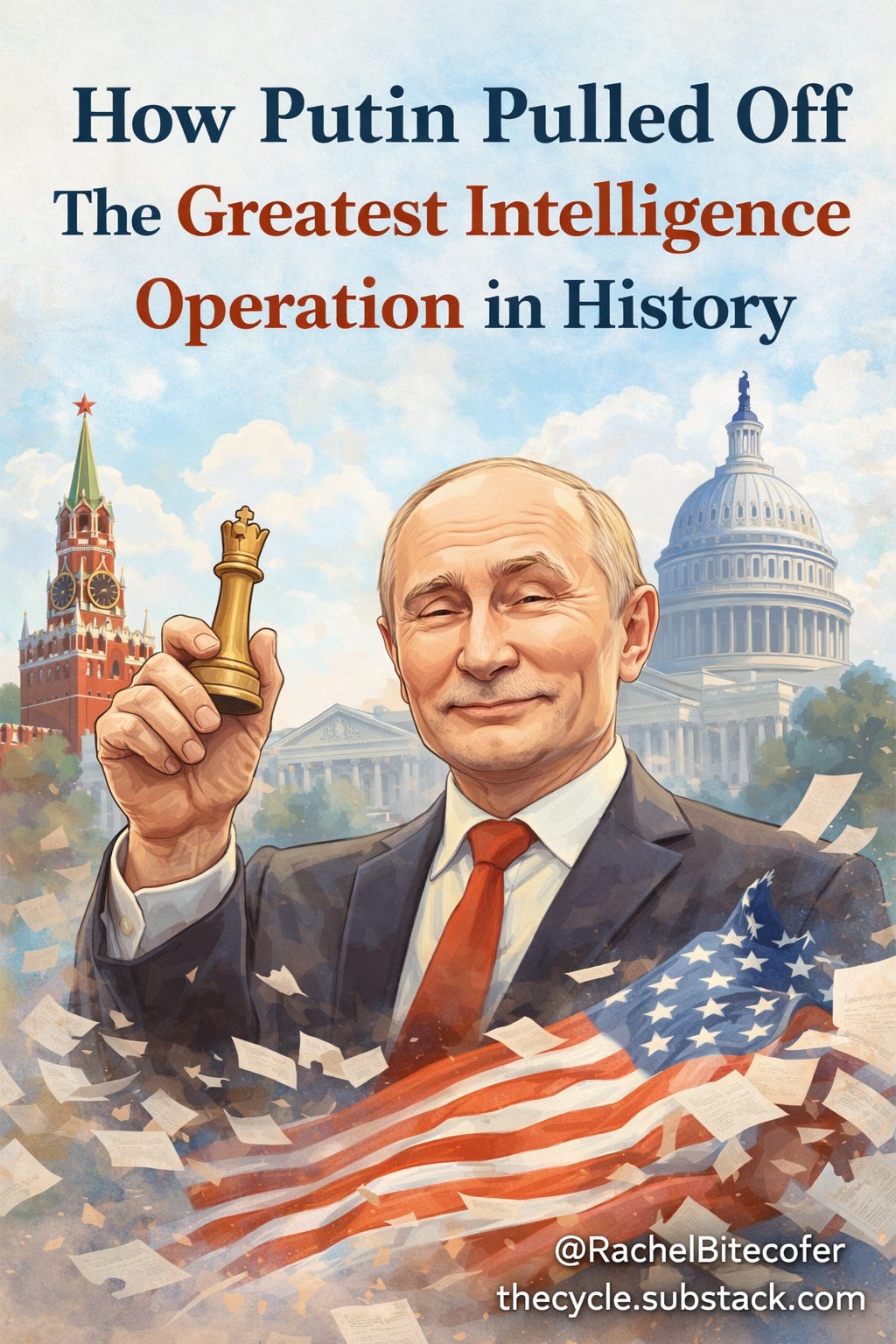
How Putin Pulled Off The Greatest Intelligence Operation in History
Putin's Small Investments Have Yielded Large Returns
This is a story about the best investment anyone’s ever made—anytime, anywhere.
Not a company.
Not a weapon.
Not a technology.
An idea.
In the early 2010s, Vladimir Putin looked at the United States and saw something most Americans refused to see about themselves. Not weakness in our military or the economy, but a country still strong by nearly every objective measure—and increasingly persuadable that it wasn’t.
By 2016, America had built the most powerful information ecosystem in human history: global reach, instant amplification, frictionless distribution, and no limits on money. And it had paired that system with almost no meaningful guardrails when it came to political speech. You couldn’t lie to sell a product. You couldn’t defraud investors. But lying to sell politics? That lives in a vast gray zone, protected by law, amplified by platforms, and rewarded by attention.
For a former intelligence officer, this wasn’t subtle. It was an open flank.
Putin didn’t need to defeat the United States militarily. He didn’t need to match American power. He just needed Americans to turn on one another inside a system designed to magnify conflict.
Why Misinformation Was the Weapon
Russia could never outspend the United States in conventional power. But modern intelligence operations aren’t about brute force. They’re about shaping environments—especially the information environments in which democratic decisions are made.
Misinformation was cheap. Scalable. Deniable. And devastatingly effective in an open society already polarized and suspicious of its institutions. The goal was never to persuade Americans of a single lie. It was to fracture shared reality itself.
If citizens can’t agree on what’s real, they can’t govern themselves. And a country that can’t govern itself is weakened, regardless of how powerful it looks on paper.
This wasn’t theory. It was practice. As laid out in the Mueller Report, Russian operatives probed and exploited the U.S. political ecosystem ahead of 2016 through two primary lines of effort: a social-media influence campaign and a hacking-and-leaking operation. The objective wasn’t policy alignment. It was destabilization.
And then there was Donald Trump.
Why Trump Was the Perfect Asset—Before He Ever Won
It’s a mistake to think Putin needed Donald Trump to win in 2016 for the operation to succeed. Victory was a bonus. Chaos was the point.
Trump was uniquely suited to tear at the fabric of American democracy whether he won or lost.
He was impulsive. Thin-skinned. Narcissistic. Easily flattered. Openly hostile to institutions. He attacked the press reflexively, distrusted intelligence agencies, and treated politics as performance rather than governance. To an intelligence professional, none of this was ambiguous. Trump’s malleability was obvious. His need for validation made him manipulable. His lack of discipline made him unpredictable.
Putin didn’t need to control Trump. He just needed Trump to be Trump.
And Trump was unstable long before Election Day.
This was a candidate who brought Bill Clinton’s accusers to a presidential debate. Who publicly encouraged a foreign power to find his opponent’s emails. Who told supporters—months in advance—that the only way he could lose was if the election were rigged.
That wasn’t reaction. It was premeditation.
From a Russian intelligence perspective, it was pure gold.
The First Payoff: January 6
Trump’s loss in 2020 didn’t end the operation. It escalated it.
After months of conditioning his supporters to expect fraud, Trump refused to accept the result. The lie hardened. The grievance metastasized. And on January 6, 2021, the United States watched a sitting president’s supporters storm the Capitol in an attempt to stop the peaceful transfer of power.
It’s worth pausing to picture this from Moscow.
Putin—former KGB officer, lifelong student of state collapse—watching Americans breach their own legislature on live television. No Russian tanks. No cyberattack. No missiles.
Just Americans doing it to themselves.
The insurrection didn’t succeed. But from an intelligence standpoint, that almost didn’t matter. What mattered was proof of concept. The system could be pushed this far. Millions could be convinced that violence was justified in defense of a lie they’d been told in advance.
From that moment on, the return on investment was no longer theoretical.
Compounding Returns: Instability, Round Two
By the time Trump returned to power, instability was no longer a byproduct. It was the platform.
The threats were explicit: claim fraud again. Punish enemies. Purge institutions. Break alliances. Rule through chaos. Uncertainty wasn’t a bug. It was the feature.
From Putin’s perspective, the returns could not have been better.
An unstable America is a distracted America. An internally fractured America is one that struggles to lead coalitions, project confidence, or reliably oppose authoritarian expansion. Even when Trump failed to fully capitulate to Russian demands—particularly on Ukraine—the damage was still done.
Signals matter.
Public threats to abandon NATO. Open contempt for allied leaders. Casual talk of coercing or threatening allies. Constant uncertainty about whether U.S. security guarantees meant anything at all.
Allies heard it. Adversaries heard it. Trust plummeted.
From Putin’s seat, watching Trump return to power after 4 separate criminal investigations and an insurrection attempt, it’s impossible not to imagine the expression on his face.
A Cheshire Cat grin.
The Greatest ROI in Modern History
Measured purely as an intelligence operation, the results are staggering.
No invasion.
No occupation.
No sustained military campaign.
Just set the fuse and watch the monkeys dance.
An electorate fractured beyond recognition. Democratic outcomes treated as optional. Violence normalized as political expression. Institutions weakened through purges.
America didn’t get here by accident. Putin leveraged right wing media and the impregnable bubble it creates to convince 30 to 40 million Americans to commit national suicide.
Putin didn’t invent America’s divisions. He recognized them. He invested in them. And like with a seed, he waited.
That’s what makes this the greatest return on investment in modern intelligence history: it convinced a superpower living through peak humanity to tear itself apart.


Fantastic essay.
Great summary—and absolutely heartbreaking. Do you follow Sarah Kendzior? She is also awesomely brilliant. On another note, I’m enjoying the cool graphics on your Substack!