
The Pentagon’s Armageddon Problem
When Christian Nationalism Runs the U.S. Military

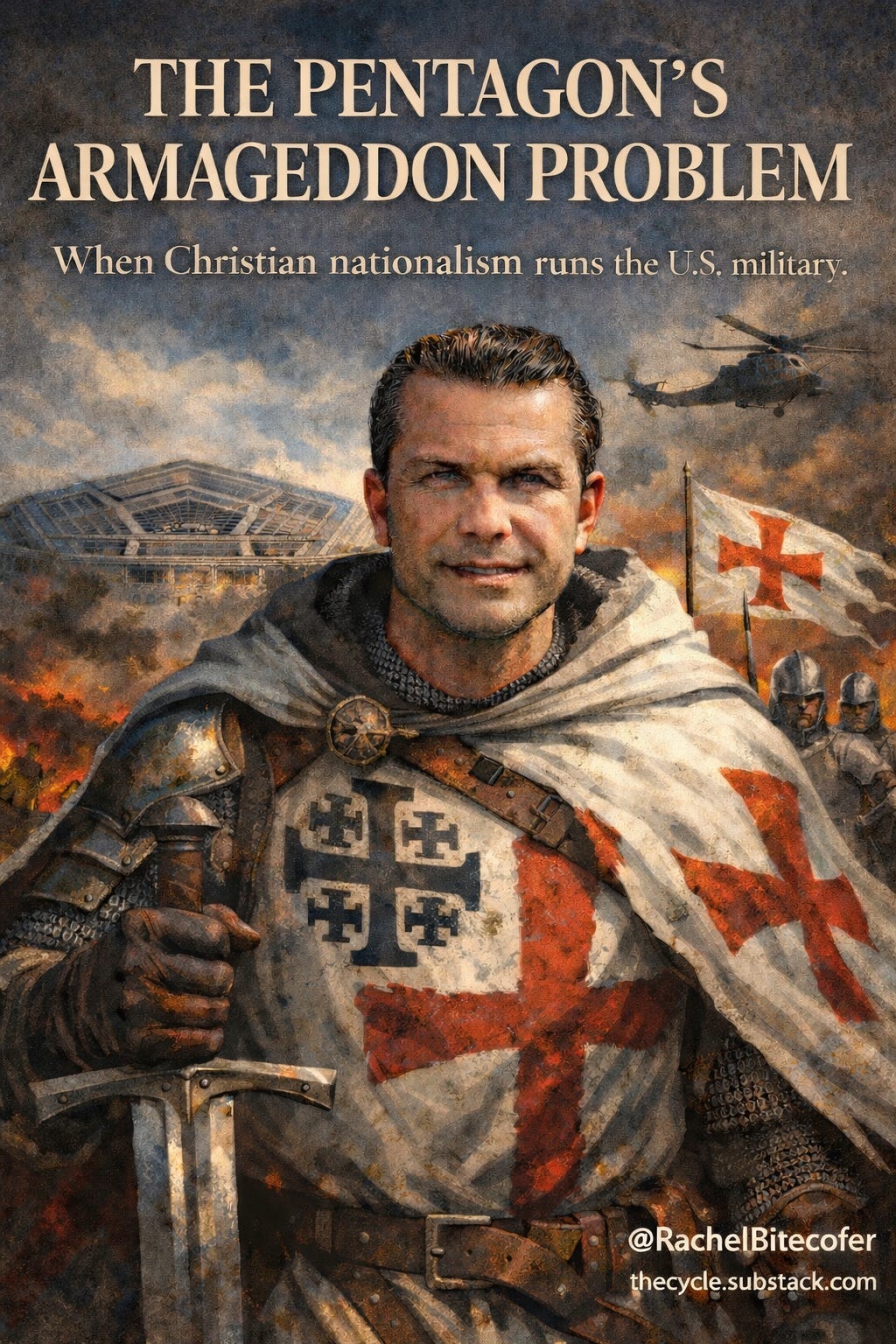
As American troops were prepped to attack Iran, some were told something rather chilling.
According to complaints filed with a military watchdog group, soldiers were briefed that the conflict unfolding in the Middle East was part of “God’s divine plan.” Some commanders reportedly referenced the Book of Revelation and framed the war in prophetic terms.
Think about that for a second.
American soldiers — sent halfway around the world with rifles and drones — being told they are participating in biblical prophecy.
This isn’t a fringe sermon happening in a megachurch somewhere. These are the kinds of ideas circulating inside the same political movement that now controls the Pentagon.
And the man currently running it, Pete Hegseth, has spent years promoting exactly the worldview that makes that framing possible.

To understand why that matters, you have to step back and look at the ideology behind it.
Because what’s shaping a huge part of the modern Republican right is not simply Christianity.
It’s white Christian nationalism — a political theology that treats the United States as a divinely chosen Christian nation and interprets global politics through a cosmic struggle between Christianity and its religious and secular enemies.
And that worldview is tattooed all over a guy who decided to call himself the the Secretary of War instead of Secretary of Defense.
Why Israel Matters So Much to Christian Nationalists
To outsiders — especially in Europe — American politics around Israel can look baffling.
Why does the American right treat support for Israel as almost sacred?
Why does it override nearly every other foreign policy calculation?
The answer lies in a particular strand of evangelical theology that exploded in influence in the United States during the twentieth century: dispensationalism.
Dispensationalism lays out a prophetic timeline for the end of the world.
According to that framework:
The Jewish people must return to the land of Israel.
Israel must exist as a modern state.
A series of escalating conflicts in the Middle East culminate in a catastrophic war often identified with Armageddon.
Only then does Jesus return to Earth.
In this worldview, Israel isn’t just another country. It’s the stage on which the final act of human history is supposed to unfold. Which means events in Israel — wars, uprisings, regional conflicts — are often interpreted not simply as geopolitical crises, but as signs that prophecy is unfolding.
The Apocalyptic Map
This theology draws heavily from passages in Daniel, Ezekiel, and the Book of Revelation.
For more than a century, American pastors, authors, and televangelists have mapped those passages onto modern geopolitics.
The resulting prophetic storyline usually looks something like this:
Israel becomes the center of global conflict
A massive war engulfs the region
Hostile nations gather against Israel
A final battle unfolds at Armageddon
Christ returns to defeat evil and establish a new kingdom
These ideas entered mainstream American culture through books like Hal Lindsey’s The Late Great Planet Earth in the 1970s and later the massively popular Left Behind Rapture novels.
Millions of Americans grew up absorbing a version of global politics in which the Middle East is not just a region of strategic importance. It’s the setting of the apocalypse and the pathway to the second coming of Jesus.
This is not fringe theology, it has shaped the worldview of tens of millions of voters and increasingly, it has shaped the worldview of Republican politicians.
Which is, I must say, is some batshit crazy stuff. And Dangerous.
Because they all believe in it literally.
Which Brings Us to Pete Hegseth
Pete Hegseth has spent years speaking in exactly this civilizational language.
He has framed Israel not simply as an ally but as a frontline in a broader struggle between Western civilization and its enemies. He has declared that “if you love America, you should love Israel.” He titled one of his books American Crusade, invoking the medieval wars between Christian Europe and the Muslim world.
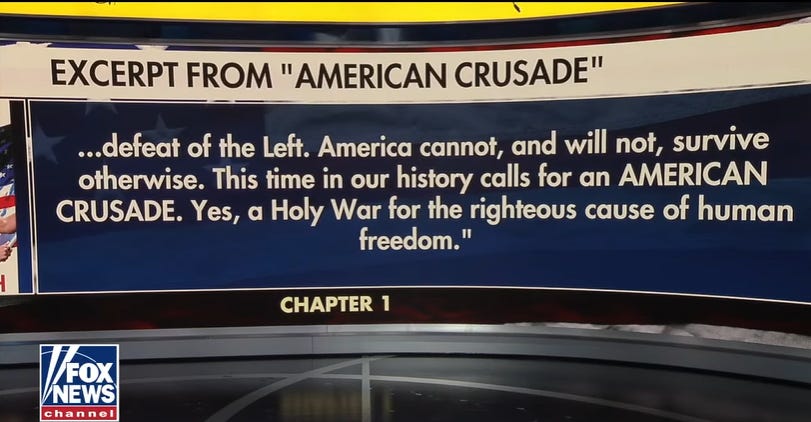
And in speeches and writing he repeatedly describes modern geopolitics as a civilizational conflict between Christian Nationalism and those who oppose it, domestic or foreign.
That framing matters.
Because once politics is interpreted through a religious lens, war stops looking like a failure of diplomacy and more like a Biblical mandate.
The Temple Mount and the End Times

One of the most revealing moments in Hegseth’s public record came during a speech in Jerusalem.
Standing within sight of the Temple Mount — one of the most contested religious sites on Earth — he suggested that the rebuilding of the Jewish temple there could happen in our lifetime and would be a miracle.
To most people, that might sound like a casual religious comment.
But in end-times theology, the rebuilding of the temple is a major prophetic milestone.
In the dispensationalist framework embraced by many Christian nationalists, the temple’s reconstruction is part of the sequence of events leading to the final confrontation described in Revelation.
In other words, it’s another step toward the end of the world.
Why This Would Sound Crazy in Europe
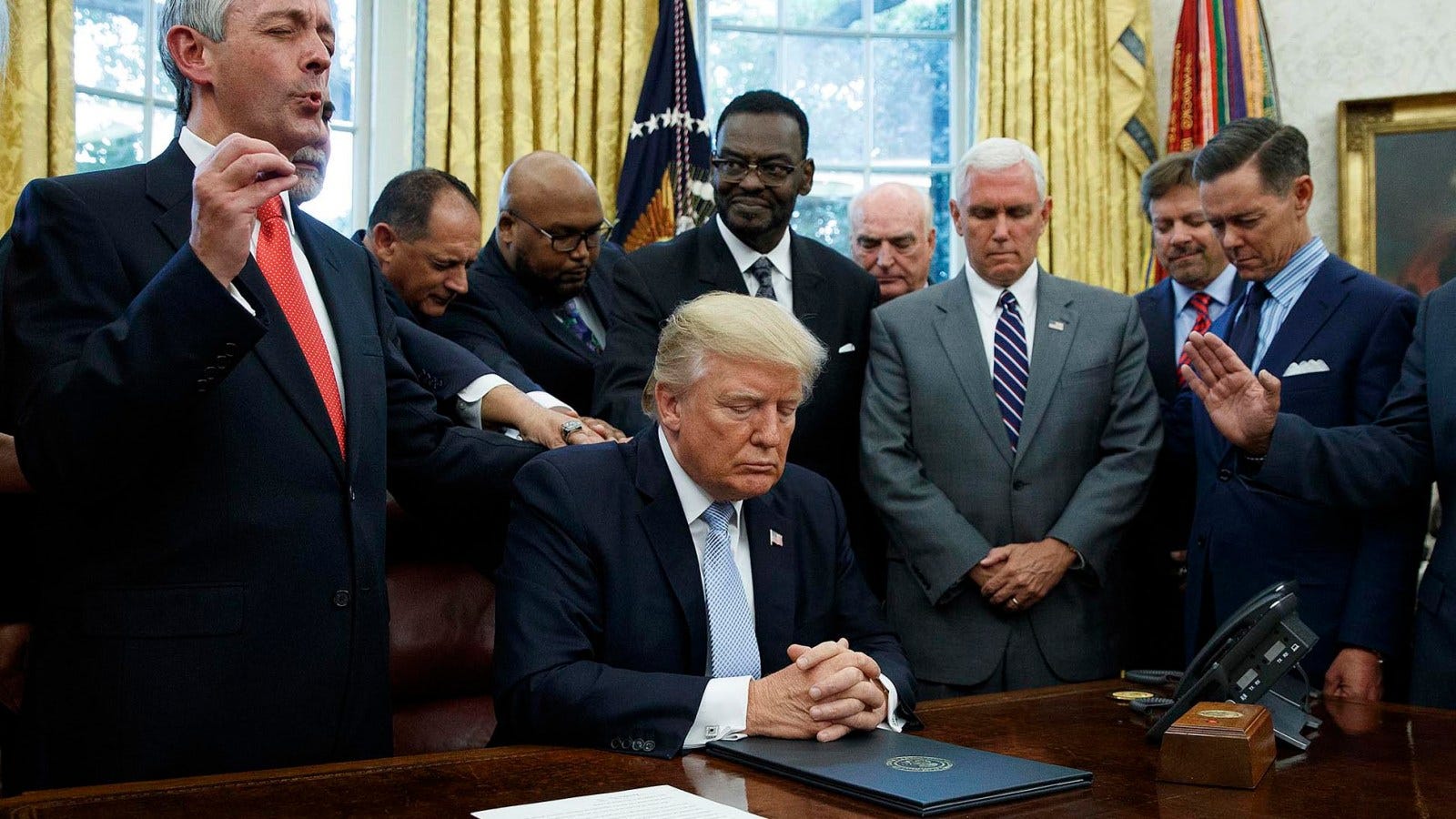
In most European democracies, the idea that senior government officials might interpret Middle East wars through the Book of Revelation would be treated as political disqualification.
American evangelical culture — especially since the Cold War — fused biblical prophecy, nationalism, and foreign policy into a single worldview. We alone believe in angels.
Over time, that worldview migrated from churches and televangelists into Republican politics. Today it sits comfortably inside the ideological ecosystem of the MAGA movement and the broader Christian nationalist right. Which means that beliefs that might sound extraordinary elsewhere are increasingly normalized here.
And they control the largest military the world has ever known, including weapons people inclined towards Revelation probably shouldn’t have control of.
The Dangerous Logic
Foreign policy decisions involving nuclear powers, regional war, and the lives of American soldiers are supposed to be made through strategic calculation.
Not biblical prophecy.
But when leaders view the Middle East through an apocalyptic lens, the incentives change. Escalation can start to feel inevitable, even meaningful.
Conflict stops being something to avoid at all costs and instead it becomes a sign that history is moving exactly where it’s supposed to go.
Don’t Fear the Reaper
For most of the post–World War II era, American foreign policy was grounded in realism — alliances, deterrence, economic interests, and strategic balance, but the rise of white Christian nationalism inside the Republican Party has introduced something very different.
A worldview in which:
The United States is a chosen Christian nation that should be run as a theocracy, not a democracy
Israel is the centerpiece of biblical prophecy
War in the Middle East is critical to eventually getting Raptured
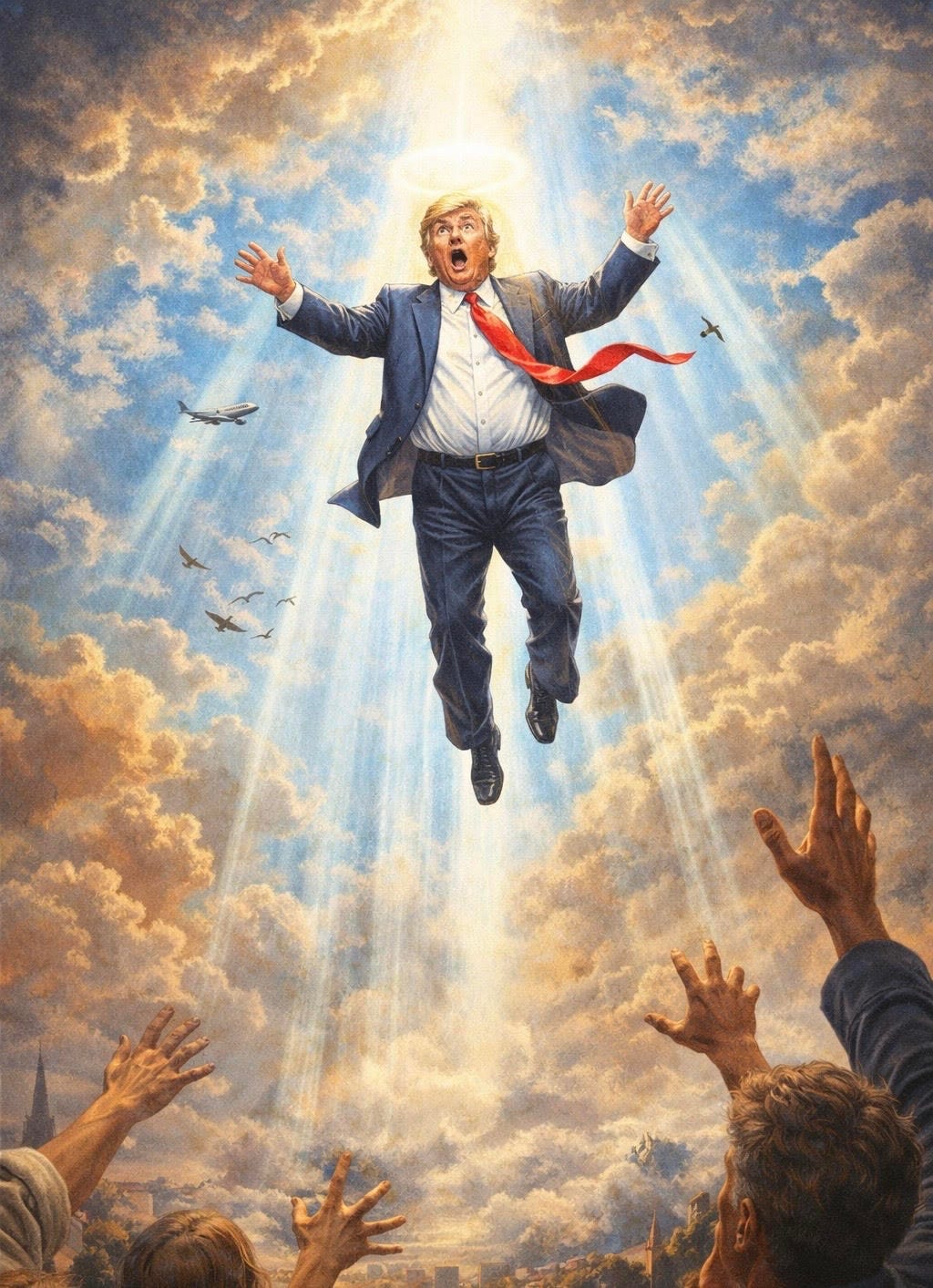
When the people running the most powerful military in human history believe that story literally, it stops being a cultural curiosity and becomes a national security issue that should terrify us all.
Dear Rachel. Thank you for putting this in perspective. As attendance in religious observation services in the United States has dropped below 40% by some accounts, the 40% belief in the final rapture holds steady in the vicinity of 80%, which far surpasses any other Western republic. The only societies that come close to these percentages are those in which shamans and witch doctors hold significant power and influence. Although Marx wrote religion is the opiate of the masses, I'm more inclined to accept religious orientation is a way to teach the unthinking basic moral principles, like love of one's neighbor, respect for the outsider, and sharing versus hoarding your possessions until the individuals reach a level of maturity in which they can think for themselves. Unfortunately, when a fanatic like Hegseth has power basic morality is not in the formula.
Thanks, Rachel. The Ambassabor to Israel is all in bigtime..